Left Of Boom
Rick Atkinson
Washington Post
October 3, 2007
The article is an interesting look at the strategies used to combat IEDs -- The last section is about LTC Gadson, and the actions taken by 1st Sgt. Frederick L. Johnson and Pfc. Eric C. Brown that helped save his life.
BAGHDAD -- In the early spring of 2006, perhaps the most important document in Baghdad was known as the MOASS -- the Mother of All Spreadsheets-- a vast compilation of radio frequencies that insurgents used to trigger roadside bombs.
In some areas of Iraq, 70 percent of all improvised explosive devices were radio-controlled, and they caused more than half of all American combat deaths. An overworked Army intelligence officer tracked the frequencies, and an equally overworked Navy electrical engineer matched them against 14 varieties of electronic jammer used by coalition forces.
As new frequencies popped up, the updated MOASS was analyzed by the National Security Agency, by Navy electronic warfare specialists in Maryland and by Army specialists in New Jersey, which led to recommended adjustments in the jammer settings. Those modified "loadsets" were then e-mailed to U.S. military forces throughout Iraq so that the jammers could be reprogrammed. The cumbersome process took weeks, by which time new frequencies had been logged into the spreadsheet, requiring further analysis and further reprogramming even as hundreds of new jammers arrived in Iraq each month. "It was a mess," a senior defense official recalled.
By the end of 2006, the Department of Defense had spent more than $1 billion during the year just on jammers. Fielding them "proved the largest technological challenge for DOD in the war, on a scale last experienced in World War II," according to Col. William G. Adamson, a former staff officer for the Joint IED Defeat Organization (JIEDDO), the Pentagon office coordinating the campaign.
The U.S. strategy was defined in six words: "Put them back on the wire." By neutralizing radio-controlled bombs, the jammers would force insurgent bombmakers to use more rudimentary triggers, such as command wire. Those triggers would be simpler to detect, in theory, and would bring the triggermen closer to their bombs, where U.S. troops could capture or kill them.
That strategy has succeeded. In the subsequent 18 months, radio-controlled bombs would shrink to 10 percent of all IEDs in Iraq. Today, bombs triggered by simple command wire have increased to 40 percent of the total.
But the threat from IEDs has barely diminished. In the first seven months of this year, there were 20,781 roadside bomb attacks in Iraq, one every 15 minutes. And as of this morning, IEDs have killed 440 U.S. troops this year. Putting them back on the wire has proved a mixed blessing.
***
Different jammers worked by different means. Active jammers screamed constantly, disrupting radio-controlled bombs with a barrage of radio waves on pre-selected frequencies that drowned out the triggering signal. Reactive jammers "scanned and jammed" by monitoring the electromagnetic spectrum -- like a human ear in a crowded restaurant listening for a voice that whispered "detonate, detonate, detonate" -- and then blocked the frequencies they were programmed to block.
Since the invasion of Iraq in March 2003, a hodgepodge of jammers had arrived in Mesopotamia, both active and reactive, weak and powerful: Warlock Green, Warlock Red, Warlock Blue, ICE, MICE, SSVJ, MMBJ, Cottonwood, Jukebox, Symphony. Collectively they were now known as CREW, an awkward acronym within an acronym: counter radio-controlled IED electronic warfare.
As more jammers flooded the war zone, the mess grew messier. For many months, the shortcomings in electronic warfare expertise had been evident among Army and Marine units. "We had all these boxes over there and people didn't know how to use them," said Rear Adm. Arch Macy, commander of the Naval Surface Warfare Center. "They'd turn them on, thinking they were protected when they weren't."
Electronic "fratricide" intensified, with more instances of jammers disrupting coalition radios and even the radio links to unmanned aerial vehicles. More troops switched off their CREW systems rather than risk disrupting their radios; rumors circulated that jammers actually detonated IEDs.
In some instances, according to a senior officer in Baghdad, investigations of fatal IED attacks revealed that "the device that killed them was triggered by a frequency that could have been stopped by proper jamming." A now-retired Army lieutenant colonel said, "There were a whole lot of things that made you just want to cry."
Among the biggest problems was simply the crowded electromagnetic environment in Iraq. Most fiber-optic and above-ground telephone lines had either been destroyed during the 2003 invasion or subsequently looted by copper-wire scavengers. Now 27 million Iraqis used unregulated cellphones, walkie-talkies, satellite phones, long-distance cordless phones and, in hundreds of instances each month, radio-controlled bombs.
About 150,000 coalition troops also sent out a great spray of electronic emissions, which mutated dramatically every time new equipment or a new contingent of soldiers arrived, including some with old Warsaw Pact electronics. "People have said it's the most challenging electromagnetic place in the world," a Navy captain said. "It's very complex." Trying to make sense of the signals, he added, was "like having your head underwater."
This was especially true in Baghdad, where the electromagnetic environment seemed to vary between neighborhoods, between seasons, between times of day. "No one realized," the senior Pentagon official said, "how much tougher jamming was going to be in the ground plane" -- the ground-air interface, where earth meets sky. The Army logistician added: "We didn't scientifically map out the problem set, so we didn't know the normal electronic noise of a taxi driver doing his thing, the doorbells, the garage door openers, the satellite communications. . . . You have to know the normal program of life."
The Pentagon would spend millions of dollars trying to replicate Baghdad's idiosyncratic airwaves in laboratories and at Yuma Proving Ground in Arizona. Senior commanders in Baghdad "were going bonkers," the Army colonel recalled. "They were saying, 'How do we fix this?' "
Worse yet, there were problems with Duke, the sophisticated reactive jammer the Pentagon had decided would replace the various models being used in Iraq. Syracuse Research Corp., a not-for-profit company created by Syracuse University in 1957, had won the competition for Duke using design concepts developed by Army engineers at Fort Monmouth, N.J. The contract was signed in June 2005, with the first Duke -- a big box with a big antenna -- completed in November. But deployment to Iraq was delayed to allow adjustments and more tests.
This state of affairs pleased no one, but it particularly displeased the Marine Corps. Marine casualties had been severe in Anbar province, where high-powered radio-controlled IEDs were pernicious. Some Marine officers also feared that they could be shortchanged as Dukes reached the field, that the Army was "taking all the good stuff," as one source put it. "The issue got ugly with recriminations."
"It was part service rivalry, part delivery schedules, and partly that no one could make stuff fast enough," said Macy, the rear admiral. "You can't walk into Circuit City and say, 'I want 25,000 high-powered jammers.' "
The Marines had already hedged their bets. Med-Eng Systems, a Canadian firm, made an active jammer that worked by "blasting away, locking up everything," according to a retired Navy captain. As a foreign firm, Med-Eng needed a U.S. partner to work on classified programs. Soon a corporate marriage was arranged with General Dynamics Armament and Technical Products in Charlotte.
If inelegant, the jammer had showed promise in tests conducted in the summer of 2005. Because it could be reprogrammed to meet changing insurgent threats, from key fobs to cellphones, the gadget was named Chameleon.
The Marines bought 1,000 Chameleons in November 2005. After encouraging tests at Johns Hopkins University Applied Physics Laboratory and elsewhere, the Marines announced on Feb. 8, 2006, a $289 million contract that increased the purchase to 4,000 Chameleons, which later grew to 10,000.
General Dynamics threw its considerable heft into the project, even using a corporate jet as a delivery van to pick up components nationwide, according to company sources. "Marines take care of their own," a General Dynamics talking point advised, but the company also eyed a bigger prize. The first Dukes had deployed overseas in February 2006, yet the jammers' difficulties in Iraq's electromagnetic environment persisted.
Noting an "Army requirement of 20,000 systems" worth $1.5 billion by 2008, General Dynamics intended to "pursue the Army requirement and displace Syracuse Research," according to a defense industry document. A corporate information campaign would promote Chameleon's virtues to Army and congressional leaders.
"We've pursued business opportunities," a General Dynamics spokesman said last week. "We were well aware of the Army requirement." A spokesman for Syracuse Research declined to comment, citing "contract restrictions."
In Baghdad, confusion only intensified as hundreds and then thousands of new jammers flooded in, some active and others reactive. Duke's shortcomings -- "it was looking like a turkey," the senior Pentagon official said -- grew so grievous by late spring that officials considered scrapping the jammer altogether in favor of Chameleon.
A naval officer, Capt. David J. "Fuzz" Harrison, had spent the winter of 2005-2006 in Baghdad trying to figure out how to fix the jammer problem. "The ground electronic warfare fight that's killing so many soldiers and Marines would be greatly aided by having people here who know electronic warfare," Harrison reported. That meant the Navy, which had extensive experience in electronic combat and had recently been chosen to coordinate all of the military's CREW systems.
Retired Gen. Montgomery C. Meigs, head of the Pentagon's counter-IED effort, returned from Baghdad in early February 2006 with similar conclusions. Expertise was needed in divisions, brigades, regiments and battalions. Harrison and Col. Kevin D. Lutz, commander of Task Force Troy, the counter-IED brigade in Iraq, calculated that nearly 300 electronic warfare officers would be required. The Navy agreed to provide them.
After brief training at Naval Air Station Whidbey Island in Washington state, the first batch of 33 Navy electronic warfare experts -- including submarine, aviation, surface ship and engineer officers and sailors -- arrived in Baghdad on April 15, 2006. Hundreds followed. Distributed throughout the force, they made an immediate impact.
Now soldiers and Marines had an expert to adjust those finicky boxes and antennas, and to offer advice on using jammers as a weapon against radio-controlled bombs. "It was," Meigs later said of the Navy's commitment, "a stroke of genius."
***
By the summer of 2006, radio-triggered IEDs had dropped to less than half the total, and they would keep plummeting for the next year. Duke became a valued battlefield asset in Iraq, and 2,300 eventually reached Afghanistan to begin replacing the venerable Acorn, which had first arrived in 2003. The integration of active and reactive jammers in both theaters proceeded apace. "Scar-tissue learning," as Meigs called the process, turned soldiers and Marines into capable electronic warriors.
Yet insurgent bombers found other options. Simple pressure plates -- two metal strips that completed an electrical firing circuit when pressed together by a tire or an unsuspecting boot -- appeared in great numbers. More than one-quarter of bomb triggers were soon classified as "VO": victim-operated.
These included growing numbers of explosively formed penetrators (EFPs), which often used passive infrared triggers tripped by a passing victim. EFPs became as flamboyant as they were deadly; a bomb with 54 warheads configured in nine "arrays" was discovered before detonation on May 17, 2006. Despite increasingly sharp warnings from the Bush administration to Iran, which was accused of supplying the bombs and other war materiel, EFPs continued to take a horrific toll in Shiite-controlled sectors of Iraq.
Six cavalry troopers would be killed in a blast on March 15 of this year, and from April 1 through July 31 roughly 300 EFP attacks occurred. EFPs still account for only about 3 percent of all roadside bombs in Iraq, but the 250 Americans killed by the devices since 2004 amount to 17 percent of all bomb deaths, according to military sources.
Underbelly or "deep buried" IEDs continued to take an even greater toll -- more than half of all coalition forces killed early this summer, for example, although only 15 percent of all bombs were classified as deep buried. The Pentagon agreed to buy at least 7,800 sturdy Mine Resistant Ambush Protected (MRAP) vehicles with V-shaped hulls for approximately $1 million each. Prudent soldiers on patrol now searched every road culvert; some units began welding shut manhole covers.
An incident on June 28 in the East Rashid neighborhood of Baghdad illuminated a disquieting trend: A single underbelly IED, so violent that investigators initially believed the blast came from several car bombs, killed five soldiers and wounded seven.
Bombmakers increasingly used homemade explosives brewed from fertilizer-based urea nitrate in kiddie swimming pools or huge aluminum cauldrons, then spread on flat rooftops to dry and packed in rice bags. On July 17, bombers detonated 1,500 pounds of homemade explosives in a culvert north of Baghdad. The blast heaved a 26-ton armored vehicle 60 feet through the air, killing two Navy crewmen, according to investigative documents. Other bombmakers in late 2006 began using acetone to leach the explosives from artillery and mortar shells; much lighter and more portable, the stuff could then be molded into car wheel wells or hidden almost anywhere.
Multiple suicide truck bombs were orchestrated to penetrate sturdy perimeter defenses, like the twin blasts in late April of this year that killed nine soldiers from the 82nd Airborne in a schoolhouse command post north of Baghdad.
Another nasty variation first appeared in October 2006 with the first use of chlorine gas in an IED. Sixteen more chlorine attacks would occur, but insurgents found, as World War I soldiers had, that "it is very difficult to create a lethal concentration of chlorine gas," an Army colonel in Baghdad reported. "The gas cloud rapidly dissipates."
***
Defeat the device. Train the force. Attack the network.
Meigs, a retired four-star Army general, had repeated those three phrases a thousand times since becoming JIEDDO director in December 2005.
In the early years of the Iraq war, the U.S. government's counter-IED efforts had focused overwhelmingly on defeating the device, and more than half of Meigs's budget still went to preventing detonation and, if that failed, mitigating the blast. In fiscal 2007, for example, $113 million would be spent on mine rollers, a World War II technology using heavy cylinders to trip pressure plate triggers in front of a convoy.
The "molecular sniffer" long coveted by U.S. Central Command arrived on the battlefield in the guise of Fido, a $25,000 machine developed by an Oklahoma company as part of a Pentagon program called Dog's Nose. Modern explosives have very low vapor pressures, and therefore emit few molecules for a sniffer to detect; but Fido's sensor -- heated above 200 degrees Fahrenheit -- was effective enough that hundreds were deployed, including more than 70 mounted on mobile robots. "This is the closest thing we can get to a dog," a government engineer said.
Some technologies thrived: Warrior Alpha drones; surveillance cameras on towers and blimps; ground penetrating radar mounted on a South African-built Husky vehicle to detect buried IEDs. In trying to "pre-det" -- prematurely detonate -- bombs with radio signals, EA-6B Prowler electronic warfare planes flew above roads in Iraq and Afghanistan. The missions were called "burning the route."
Other technologies flopped. Forerunner, an unmanned vehicle carrying counter-IED gear, was to be "tele-operated" with remote controls by soldiers in a trailing vehicle. It "simply did not work" and was banished from the theater, according to a JIEDDO document. The controls proved sluggish, and some operators developed motion sickness while trying to drive Forerunner via a television monitor in the jouncing trail Humvee.
Still more disappointing was Blow Torch, a high-powered microwave emitter built at Letterkenny Army Depot in Pennsylvania after besting four rivals in a government competition. Similar to an Israeli gadget called Dragon Spike, Blow Torch was intended to defeat the electronic circuitry in EFPs. At $175,000 each, 101 of the devices took to the field for operational testing early this year. But enduring shortcomings halted the deployment and Blow Torch was diverted to New Mexico for more testing.
Also frustrating was the scientific effort to detect the gossamer-like copper wires increasingly used to arm or detonate bombs, including about one-third of all EFPs by this summer. Certain airborne search radars gave good resolution -- a clear picture -- when looking for a thin wire strung from a hidden roadside bomb to a triggerman. But those radars failed to penetrate beneath the surface for wires slightly buried, while radars that penetrated gave poor resolution. Different soils produced varying results, depending on moisture content, alkaline levels and other arcane variables. False positives were legion in wire-strewn, trash-cluttered Iraq.
Meanwhile, the jammer saga rolled on. By midsummer, 13,000 Dukes had arrived, to be followed by an improved Duke 2. The Pentagon also signed contracts with EDO Corp. for more than $535 million to buy the first 7,450 of an eventual 11,000 jammers -- known collectively as Spiral 2.1 -- intended as the next CREW generation in Iraq and Afghanistan. Research and development has already begun on Spirals 3.1, 3.2 and 3.3, according to the Navy.
Few issues were more emotionally charged. Since early 2006, Rep. Duncan Hunter (R-Calif.), chairman of the House Armed Services Committee, had urged a "Take Back the Roads" campaign in Iraq. Among other solutions, he advocated a backpack jammer known as the Quick Reaction Dismounted (QRD), which would succeed the little Warlock Blue he had pushed into the field a year earlier. When a staffer called Hunter from Yuma and told him that "they have 163 more iterations of the tests still to go" on the QRD, the chairman angrily accused Meigs of "the slows" and of "delaying things from getting into the hands of the troops," according to sources familiar with the incident.
Meigs was furious. The backpack jammer was not ready for deployment, he countered, and the Duke's persistent difficulties had disrupted the test schedule at Yuma. Eventually the Pentagon announced that 1,400 backpack jammers -- a QRD model called the Guardian won the competition -- would be sent to the theater by spring of this year. (Hunter lost his chairmanship in January when Democrats took control of the House.)
Armor remained the last line of defense, and armor grew ever thicker, heavier and more expensive. Seven major vendors toiled to build the V-shaped MRAPs, and the Pentagon pondered whether to triple the buy, to 23,000 vehicles, in order to replace all Humvees in Iraq, according to senior officials. By the end of 2007, 1,300 MRAPs were to be built each month, compared with fewer than one a day a year earlier. For expediency, plans were made to fly at least some MRAPs to the war zone at a cost of $135,000 each, seven times the expense of sea transport.
A Marine general this spring publicly declared the MRAP to be "four to five times safer" than an uparmored Humvee, but Pentagon officials conceded that it remains vulnerable to EFPs and large underbelly bombs, as well as to anti-tank missiles and rocket-propelled grenades. An even stouter model, designed to better parry EFPs, is under consideration.
The Pentagon in the past year also financed more than 8,000 anti-fragmentation kits, known as Frag Kit 5, which added still more armor plating to Humvees. Frag Kit 6, a still heavier version, will have doors weighing 650 pounds each -- so bulky that soldiers may need a "mechanical assist device" to open and close them. "It's over the top," said an Army colonel in Baghdad.
***
Training the force, Meigs's second imperative, has saved innumerable lives over the years. Soldiers who once spotted few roadside bombs in Iraq now detect more than half before detonation.
The "Mark 1 Human Eyeball," as troops sardonically call it, is more adept at finding IEDs than any machine. Studies to determine which soldiers made the best bomb spotters found that "it's those who hunted and fished and were much closer to their environment," an Army scientist reported. Because approximately half of all casualties occurred in the first three months of a soldier's deployment, according to a senior intelligence official, units headed overseas began receiving extensive counter-IED instruction at the Army's National Training Center in California and elsewhere.
In Iraq, SKTs -- "small kill teams" -- of five to eight soldiers learned to ambush bomb emplacers, often hiding for hours or days near IED "hot spots." Under a $258 million contract, Wexford Group International of Vienna, Va., and the Asymmetric Warfare Group, a new Army unit formed last year at Fort Meade, Md., dispatched field teams to the theater to help sharpen tactics and techniques. Troops were advised to "get off the X" -- the blast seat in an IED attack -- and to "build a box," with surveillance cameras, for example, in which to spot and trap insurgent bombers.
The new unit, now 250 strong, adopted an eccentric motto: "Normal is a cycle on a washing machine." Field commanders were urged to be unorthodox, by leaving an eavesdropping bug after searching a suspected insurgent hideout, or by shutting down microwave towers to neutralize cellphone triggers before entering a dangerous sector.
"Our mission is to challenge the culture of the whole Army," said Col. Robert Shaw, the group commander. "The institution is not designed to react as fast as our enemy reacts."
Last winter, another new Army unit, Task Force ODIN -- the acronym derives from "observation, detection, identification and neutralization" -- began hunting IED emplacers with unmanned aerial vehicles, attack helicopters and spotters in C-12 airplanes. Operating from Tikrit in northern Iraq, the task force eventually averaged "40 to 50 engagements per month," according to a senior Army official. A sequence of operations in northern Iraq -- code-named Snake Hunter, Snake Killer and Black Widow -- increased the number of suspected emplacers killed from a weekly average of 22 last fall to 71 per week this spring, an Army lieutenant colonel said.
"The enemy's killing us with a thousand cuts, and we're trying to kill him with a thousand cuts, too," the lieutenant colonel added. "Can you kill your way to victory?"
***
Ultimately, eliminating IEDs as a weapon of strategic influence -- the U.S. government's explicit ambition -- is likely to depend on neutralizing the networks that buy, build and disseminate bombs. Military strategists have acknowledged that reality almost since the beginning of the long war, but only in the past year has it become an overarching counter-IED policy. "Left of boom" -- the concept of disrupting the bomb chain long before detonation -- is finally more than a slogan.
"If you don't go after the network, you're never going to stop these guys. Never. They'll just keep killing people," the senior Pentagon official said. "And the network is not a single monolithic organization, but rather a loosely knotted web of networks."
The resemblance of bomber cells to a criminal enterprise has meant a greater reliance on law enforcement techniques, an approach Meigs had stressed as commander of NATO forces in Bosnia in the late 1990s. In Iraq, that has included such tactics as analyzing the copper found in an EFP slug to determine where it was mined and bringing modern forensics to Mesopotamia.
"We were policing up guys on the battlefield and turning them over to the Iraqi judicial system, which was releasing them because we didn't have any experience in gathering evidence," the senior intelligence official said. Convictions in 2006 ran as low as 20 percent in some areas.
Eventually, 18 weapons intelligence teams, drawn largely from the Air Force, began collecting evidence both from bombs that detonated and from those that did not. At Task Force Troy in Baghdad, four cyanoacrylate fuming chambers now use a concoction of Super Glue and high humidity to tease latent fingerprints from electrical tape or IED components. One million known Iraqi fingerprints are stored at a Pentagon biometrics center in West Virginia. In the first seven months of this year, technicians examined 112,000 items and recovered an average of 600 latent prints each month.
In June, for example, 17 fingerprint matches led to the detention of 10 Iraqi suspects and a hunt for seven others, officials said. Because the Iraqi judicial system traditionally has relied on confessions, witness statements and photographic evidence, two American forensics experts on July 13 gave 30 judges at the Central Criminal Court in Baghdad a 90-minute tutorial on fingerprinting. U.S. officials hope to begin introducing fingerprint evidence in Iraqi trials this year.
Ninety retired agents from the FBI, the Drug Enforcement Administration and other agencies also have been hired as field investigators in a $35 million pilot program that began a year ago. About 150 prosecutions for bombmaking activities have taken place in Anbar province alone, according to a Defense Intelligence Agency analyst.
Other unconventional initiatives include "human terrain teams," made up of anthropologists, social scientists and sundry experts who advise brigade commanders on tribal structure, local customs and cultural nuances. A preliminary assessment last month of an HTT in eastern Afghanistan concluded that the team had "a profound effect" in reducing "kinetic operations" -- gunplay -- and had even discerned that a local village would help stop Taliban rocket attacks against U.S. troops in exchange for a volleyball net. From an original $20 million plan for half a dozen teams, the Pentagon now envisions nearly 30.
To anticipate future bomb designs, scientific "red teams" last year began building IEDs that insurgents might build, while "blue teams" calculated how best to defeat them. Other red teams include 100 cadets and midshipmen from the nation's military academies, who have also been recruited as surrogate bombmakers. "Show me how many different ways you can flip a switch at a distance," the students were told. "Be conceptually sophisticated, but use the most simple, cheap and available material that you can."
Last fall, in an office building in Northern Virginia, a JIEDDO operation began fusing data from the CIA, the DIA, the NSA other organizations in an effort to give brigade commanders timely intelligence for targeting IED networks. Telephone eavesdropping, surveillance video, spy reports, roadside-bomb trends: all are packaged electronically and sent forward. The operation can build in 12 hours a three-dimensional video showing, for example, a street in Ramadi or Baqubah where an Army patrol intends to drive tomorrow, with extraordinary detail about past IED events on this corner or down that alley.
Attack-the-network results have been heartening in recent months, according to Pentagon officials, who cite the seizure of bomb caches and the destruction of several cells. Still, scarcely an hour passes in Iraq without someone planting a bomb.
"It's a hard problem. There is no solution, just better ways of dealing with it," Deputy Defense Secretary Gordon R. England said in an interview. "You keep mitigating as much as you can, but at the end of the day, it's warfare."
***
At 9:30 p.m. on Monday, May 7, a convoy of four uparmored Humvees rolled through the heavily fortified gate at Camp Falcon in southern Baghdad before turning north onto Route Jackson at 35 mph. Each Humvee carried a jammer against radio-controlled bombs, either a Duke or an SSVJ. Each had been outfitted with Frag Kit 5, and a Rhino II protruded from each front bumper as protection against EFPs detonated by passive infrared triggers. As recommended, the drivers kept a 40-meter separation from one another.
The senior officer in the third Humvee, Lt. Col. Gregory D. Gadson, 41, had driven to Falcon to attend a memorial service for two soldiers killed by an IED. Now he was returning to his own command post near Baghdad International Airport. As commander of the 2nd Battalion of the 32nd Field Artillery, a unit in the 1st Infantry Division, Gadson was a gunner by training. But as part of the troop "surge" that President Bush announced in January, the battalion had taken up unfamiliar duties as light infantrymen in Baghdad.
After 18 years in the Army, including tours of duty in the 1991 Persian Gulf War and in Afghanistan, Gadson was hardly shocked by the change of mission. He knew that, proverbially, no plan survived contact with the enemy. Raised in Chesapeake, Va., he had been a football star in high school and an outside linebacker at West Point before graduating in 1989. The nomadic Army life suited him and his wife, Kim, who had been a classmate at the academy before resigning her commission to raise their two children.
In the darkness on Route Jackson, no one noticed the dimple in the roadbed, where insurgents had loosened the asphalt with burning tires and buried three 130mm artillery shells before repairing the hole. No one saw the command wire snaking to the east through a hole in a chain-link fence and into a building. No one saw the triggerman.
They all heard the blast. "The boom is what I think about every day," Gadson would say three months later at Walter Reed Army Medical Center. A great flash exploded beneath the right front fender. Gadson felt himself tumbling across the ground, and he knew instantly that an IED had struck the Humvee. "I don't have my rifle," he told himself, and then the world went black.
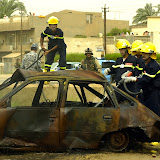
When he regained consciousness, he saw the looming face of 1st Sgt. Frederick L. Johnson, who had been in the trail vehicle and had brought his commander back from the dead with mouth-to-mouth resuscitation. Lying on the road shoulder 50 meters from his shattered Humvee, Gadson was the only man seriously wounded in the attack, but those wounds were grievous. Another soldier, Pfc. Eric C. Brown, managed to knot tourniquets across his upper thighs. Johnson hoisted Gadson, who weighed 210 pounds, into another Humvee, an ordeal that was "extremely complicated due to the extensive injuries Lt. Col. Gadson sustained to his lower extremities," an incident report later noted.
Thirty minutes after the blast, Gadson was flown from Camp Falcon to the 28th Combat Support Hospital in Baghdad's Green Zone. For hours he hovered near death, saved by 70 units of transfused blood. "Tell Kim I love her," he told another officer.
Two days later, he was stable enough to fly to Landstuhl Regional Medical Center in Germany; two days after that, he reached Walter Reed, where Kim was waiting for him. On May 18, a major artery in his left leg ruptured; to save his life, surgeons amputated several inches above the knee. The next day, the right leg blew, and it, too, was taken off at the thigh.
Gadson would be but one of 22,000 American casualties from IEDs in Iraq and Afghanistan, but that isolated incident along Route Jackson on May 7 was emblematic of the nation's long struggle against roadside bombs.
He had been wounded despite the best equipment his country could give him and despite the best countermeasures American science could contrive. His life had been saved by the armored door that shielded his head and torso, and by the superior training of his soldiers, the heroic efforts of military medicine and his own formidable grit. He had lost his lower limbs despite flawlessly following standard operating procedure. He faced months, and years, of surgery, rehabilitation and learning to live a life without legs.
Gadson's war was over, but for his comrades and for the country it goes on. An additional $4.5 billion has been budgeted for the counter-IED fight in the fiscal year that began this week. JIEDDO, which started four years ago this month in the Pentagon basement as an Army task force with a dozen soldiers, now fills two floors of an office building in Crystal City and employs almost 500 people, including contractors.
The House Armed Services Committee concluded in May that the organization "has demonstrated marginal success in achieving its stated mission to eliminate the IED as a weapon of strategic influence." Others disagree, including England. "Monty Meigs was the best thing that ever happened to us," he said, "and to the [Pentagon], and to the guys in the field."
Whether because of the surge, or despite it, total IED attacks in Iraq declined from 3,200 in March to 2,700 in July, an 8 percent drop. IED-related deaths also declined over the summer, sharply, from 88 in May to 27 in September.
If heartened by the recent trend, Meigs is cautious. He notes that sniping, another asymmetrical tactic, tormented soldiers in the Civil War. "Snipers are still around, and they're darned effective," he said. "Artillery has also been around a long time. There are some tactical problems that are very hard to solve. There are no silver bullets, no panaceas."
Virtually everyone agrees that regardless of how the American expeditions in Iraq and Afghanistan play out, the roadside bomb has become a fixture on 21st-century battlegrounds.
"IEDs are a factor in the future," Macy added. "Wherever we go, for whatever reason we go there, if there are people who don't like us, we're going to have to be prepared to deal with IEDs."



 Subscribe To Site Feed


