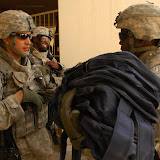
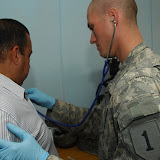
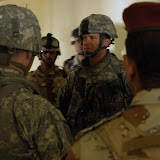
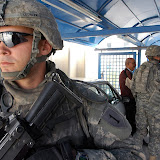
Homecoming

Homecoming
Redeployment Ceremony; April 22nd, 2008

In The News

Articles, pictures, and other news about the 2-32 Field Artillery, and the area (Yarmouk and Hateen neighborhoods) where they've been working. For posts older than 30 days, check the archive links on the left, or use the searchbox at the top of the page.

[last update: April 22, 2008]

Wednesday, December 12, 2007

Security Incidents

Daily Security Updates
McClatchy News

December 11, 2007

Around 5.30 p.m., gunmen riding a sedan car opened fire on an Iraqi army check point near Um Al-Tiboul mosque in Yarmouk neighborhood ( west Baghdad) injuring three [Iraqi] soldiers of that check point

Mosque Monitoring

Mosque Monitoring
DVIDS
Date Taken: October 12th, 2007
Photographer: Spc. Sharhonda Mccoy

Mosque Monitoring

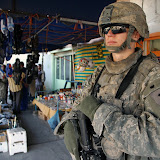
  • U.S. Army Cpl. Matthew Whiting and Spc. Jose Tavarez from Bravo Battery, 2nd Battalion, 32nd Field Artillery, 2nd Brigade Combat Team, 1st Infantry Division, Fort Riley, Kan., provide security in Yarmuk, Iraq, Oct. 12.

  • U.S. Army Sgt. Zhuoang Cao from Bravo Battery, 2nd Battalion, 32nd Field Artillery, 2nd Brigade Combat Team, 1st Infantry Division, Fort Riley, Kan., have a conversation with Iraqi children while providing security in Yarmuk, Iraq, Oct. 12.

  • U.S. Army Cpl. Matthew Whiting and Spc. Jose Tavarez from Bravo Battery, 2nd Battalion, 32nd Field Artillery, 2nd Brigade Combat Team, 1st Infantry Division, Fort Riley, Kan., converse with Iraqi civilians while providing security in Yarmuk, Iraq, Oct. 12.

Security Incidents

Daily Security Updates
McClatchy News

December 10, 2007

2 national police members were injured in an IED explosion that targeted their patrol in Qahtan square in Yarmouk neighborhood west Baghdad around 5,30 pm.


Wednesday, December 5, 2007

Thekhar Primary School

Thekhar Primary School
DVIDS
Photographer: Spc. Charles Gill
Date Taken: November 9th, 2007

Thekhar Primary School 20071130

Iraqi Police Auxiliary Recruiting Mission

Iraqi Police Auxiliary Recruiting Mission
DVIDS
November 19th, 2007
Photographer: Spc. Charles Gill

Iraqi Police Auxillery Recruitment 12052007

Security Incidents

Security Incidents
McClatchy News
December 5, 2007

Around 11.30 a.m., a roadside bomb targeted a police patrol near Yarmouk hospital on the way to Nisour intersection injuring two policemen

Friday, November 30, 2007

Video: Iraqi Auxillary Force Recruiting Drive (unedited footage)

Video: Iraqi Auxillary Force Recruiting Drive
Digital Video and Imagery Distribution
Date Taken: 11-29-2007

DVIDS page
Direct Link to Video

Interviewee(s):
• Spc. Justin Henckel (US)
• 1st Lt. Neal Rice (US)
• Capt. Jason Morgan (US)

B-roll made of "Iraqi Auxillary Force Recruiting Drive" in the package section of an Iraqi auxiliary force recruiting drive. Scenes include the processing of Iraqi citizens, medical screening, background checks, Iraqis taking a fitness assessment and interviews. Produced by Sgt. Marie Exley.

Video: Iraqi Auxillary Force Recruiting Drive (finished video)

Video: Iraqi Auxillary Force Recruiting Drive
Digital Video and Imagery Distribution

Date Taken: 11-29-2007

DVIDS page
Direct Link to Video

Video Location:
IQ||Yarmouk

Interviewee(s):
• Spc. Justin Henckel (US)
• 1st Lt. Neal Rice (US)
• Capt. Jason Morgan (US)

Package of an Iraqi Auxiliary Force recruiting drive in Yarmouk to try and become Iraqi police. Also see "Iraqi Auxiliary Force Recruiting Drive" in the B-roll section.

Tuesday, November 27, 2007

Iraqis Line Up to Join Auxiliary

Iraqis Line Up to Join Auxiliary
Digital Video and Imagery Distribution

Sgt. 1st Class Robert Timmons
11.27.2007

iraqis line up to join auxillery 20071127

It has been a long, hard deployment for the Soldiers serving in Iraq. Threats of improvised explosive devices, snipers and chaos seemed to hide around every corner.

Yet through it all, the rates of attacks against coalition forces and their Iraqi counterparts are dropping. The Associated Press reported U.S. commanders as saying violence is down 55 percent since the surge of 30,000 troops arrived in the city.

Is this decrease a matter of more Soldiers patrolling the troubled streets of the Iraqi capital or is it because more Iraqis are standing up to the extremists to take their part and end the cycle of violence?

Amid the myriad reasons for the decrease, one thing is certain; Iraqis are lining up by the hundreds to join Iraqi police auxiliary forces.

These forces, though paid less than Iraqi policemen and may one day becoming full-fledged police officers, are tasked with protecting their own neighborhoods or muhallahs.

On Nov. 17 and 19, troops from 2nd Battalion, 32nd Field Artillery Regiment along with their Iraqi security forces brethren held recruitment drives to sign up these volunteers in the Hateen and Yarmouk neighborhoods.

At the Nov. 17 drive, sponsored by Battery A, over 175 recruits volunteered, while at the Battery B drive in Yarmouk, 47 went through the recruitment.

“It is extremely important,” said Dana, Ky., native Sgt. Michael Webb, a petroleum supply specialist from Battery A, 2nd Bn. 32nd Field Artillery, who manned the final out processing station at the event. “We are giving back to the Iraqi people. It is very important for them to help take care of themselves.”

During the drives, the recruits had to pass through a security checkpoint, a brief medical screening, a biometrics check, an interview with local ISF commanders and a physical fitness test before they could see Webb to get their final processing.

“This was planned for a couple weeks,” the 32-year-old said. “We have been able to move people through efficiently through good communications.”

He added that there was a good deal of interpreters at the event which helped speed it along.

One of the most important steps in the process was ensuring no recruits had a suspicious background.

“We do biometrics checks to see if they come up on any list,” said Staff Sgt. Steven Guiffre, a military policeman with the 401st Military Police Company who oversaw the taking of fingerprints and retinal scans. “This helps eliminate those you don’t want as a policeman.”

The data gathered is put into a computer database which checks to see if the person is who they claim to be and if they are suspected of criminal activity.

The Waterbury, Conn., native whose unit helps train Iraqi police officers said it is important for Iraq to have a good strong police force.

“You don’t have a totally free society with the Iraqi army pulling security,” he said. “Let the police take care of the towns and let the army take care of the country.”

To ease any sectarian tensions, any male over the age of 17 was allowed to volunteer regardless if they were Sunni or Shia.

“Everybody is allowed to volunteer as long as they live in the area,” said Bloomington, Ind., native, Staff Sgt. Patrick Whaley, the battalion’s Civil Military Operations platoon sergeant. “This is a good step in the right direction for the Mansour area, especially Hateen. It gets the locals working with the (Iraqi security forces) as they police their communities.”

The 37-year-old father of a 19-year-old private said during the Hateen recruitment drive that a few months ago the idea of this many people showing up would have been laughed at.

“We had over 175 people show up today,” he said. “Six to seven months ago you wouldn’t even have had half that many.”

While the numbers seem small compared to larger neighborhoods like Saydiyah or Doura where the numbers reached up into the high hundreds, the IPA will soon hit the streets to help rid the city of criminals.

Monday, November 26, 2007

Guarding Principles

Guarding Principles
Digital Video and Imagery Distribution
Sgt. 1st Class Robert Timmons
November 25th, 2007

guarding principles

Newaygo, Mich., native Spc. Ron Lethorn, a 30-year-old cannon crew member with the 2nd Battalion, 32nd Field Artillery Regiment, personal security detachment, stands guard as Lt. Col. Michael J. Lawson speaks to local Iraqis during an Iraqi Police Auxiliary recruitment drive in Hateen Nov. 17. The 2nd Bn. 32nd Field Artillery is currently attached to the 2nd Brigade, 101st Airborne Division, but is an organic part of the 4th Brigade Combat Team, 1st Inf. Div. based at Fort Riley, Kan.

Platoon Sells Itself to Help Iraqis

Platoon Sells Itself to Help Iraqis
Digital Video and Imagery Distribution

Sgt. 1st Class Robert Timmons
11.26.2007

to help iraqis 20071126

The Iraqi children come up to the Americans with broad smiles on their faces. Some ask for soccer balls like thousands of other kids across the country, but some of these just wanted to talk with the heavily-armored troops who have brought calm to their little corner of the Iraqi capital.

These are the children at the Daklea Market in Baghdad and on Nov. 18 Soldiers from the 2nd Battalion, 32nd Field Artillery Regiment’s Civil Military Operations platoon were there to take a census of sorts among the shop owners.

The platoon was finishing up documenting all the shop owners in the area. That day they catalogued the last shops.

“It’s all about sales,” said 1st Lt. Quinn Robertson, the platoon’s leader from Richmond, Va., who sold stocks before joining the Army. “It’s all about selling yourself. That’s how you talk to them.”

Robertson’s strong background in the business world and his time as a battery executive officer and battalion intelligence officer have served him well with the platoon he said. He said it gives him the chance to help reintroduce the Iraqis to the process of rebuilding their nation.

“It’s all about the relationship building,” he said after meeting and greeting various Iraqis at the market. “They don’t come from the same backgrounds as we do, so we are reintroducing them to the process – the who and where you get the money from to get things done. The way you talk to them goes a long way.”

The CMO platoon, which was created in September was the brainchild of former Civil-Military Officer, 1st Lt. Alex Barnett, who saw its creation as a way to free up combat power, said Lancaster, Pa., native 1st Lt. Neal Rice, the battalion’s civil military operations officer.

“Before we had the platoon, line platoons were escorting us all over the battlefield,” the 27-year-old said. “CMO became such a big part of our mission that we were getting inundated. So the commander said, ‘Let’s get a platoon.’ Now CMO has freedom of movement anywhere in the area of operations.”

The platoon made up of various military occupational specialties including administrative, medical, infantry and cannon crewmembers has helped calm a once restive market.

The battalion, and the platoon, brought a religious leader over to their side with signs of progress Robertson said.

“He was not exactly on the fence,” he said. “But we brought him onto the fence then our actions brought him over. We asked if he was the power in the neighborhood and he said, ‘Yes.’ So we put him together with the neighborhood council. With the NAC and him together the bad guys could only take him so far.”

And the neighborhood began to steadily improve, he added.

Besides helping get the Daklea Market back on its feet the platoon is tasked with “getting sewage off the streets, getting the pumping stations working, assessing schools and assisting the Iraqi police auxiliary in Yarmouk,” said Staff Sgt. Patrick Whaley, an infantryman from Bloomington, Ind., and CMO platoon sergeant.

The platoon also helped with IPA recruitment drives in Hateen and Yarmouk.

But, the success of the platoon goes back to one thing, Robertson said.

“It’s all about relationship building,” the 33-year-old five-year Army veteran said.

‘Like a Pit Crew,’ Mechanics Keep Batteries Firing

‘Like a Pit Crew,’ Mechanics Keep Batteries Firing
Digital Video and Imagery Distribution

Sgt. 1st Class Robert Timmons
11.26.2007

mechanics 20071126


To support Operation Iraqi Freedom all units, whether infantry, engineers, armor and even artillery, have been called on to fill non-traditional roles and hit the streets.

Such is the case with the 2nd Battalion, 32nd Field Artillery Regiment, a part of the 4th Brigade Combat Team, 1st Infantry Division back at Fort Riley where they call home, but while deployed are attached to the 2nd Brigade, 101st Airborne Division. They have traded in their howitzers for Humvees so they can mingle with the residents of Hateen and Yarmouk.

While the artillerymen walk the streets, of arguably one of the quietest neighborhoods in the city, mechanics at base camp keep the battalion’s wheels to the road.

The troopers of Company G, 610th Brigade Support Battalion, the “Proud Americans” forward support company, don’t just wait for vehicles to break down: they provide all types of support for the battalion including recovering disabled vehicles and getting them repaired for the next mission.

“It’s important here to keep the trucks on the road,” said Vero Beach, Fla., native Chief Warrant Officer Richard Jones, who heads the company’s mechanic shop. “We are here 24/7; after the mission is over and the (after action reviews) are done they bring their vehicles here to see if anything is broken.”

While the battalion had to change its focus from pounding the enemy with high-explosive shells to pounding the streets, the mechanics had to learn on the fly how to assess and fix the different style of Humvees used here.

“They didn’t have a lot of experience in these types of vehicles,” the 16 and half year Army veteran and father of three said. “But we have an outstanding bunch of mechanics here. It took time learning to troubleshoot the vehicles. The vehicles are different from that in the rear, they have different electronics and generator systems.

“It took a good 90 days for them to get used to the (M1151s) – now they are a regular pit crew.”

M1151 Humvees are the latest generation of Army vehicles which are built with heavier armor and sturdier drive trains than older models.

“The M998 Humvees we worked on at Fort Riley were a little different,” said shift supervisor Sgt. Thomas Shulte, a 29-year-old from Detroit. “They don’t have all the armor on them and it made it a lot easier. In the 1151s, a lot of stuff is packed into the work area. It’s much easier to work on once you know what you are looking for.”

Schulte, who took up fixing cars as a hobby, said the mechanics rotate between working the day shift and night shift. “There is a non-commissioned officer and several Soldiers here at night.”

During the dayshift, the Soldiers concentrate on routine servicing of vehicles, ensuring preventative maintenance checks and services are done on the trucks before they are dispatched and any other problems the trucks may have.

When doing routine maintenance, the Humvees are examined top to bottom, front to back, as the mechanics look for anything out of the ordinary.

“We make sure there is no dry rot,” Schulte said. “In these conditions the ball joints fail and tie rods bend. In this environment they fail a lot.”

Even with that challenge, Shulte and his team are proud of what they do and look forward to rejoining the rest of the Dragon Brigade once they redeploy.


Wednesday, November 21, 2007

Baghdad Set to Serve up Turkey

Baghdad Set to Serve up Turkey
Army News Service
BY Pfc. April Campbell
Nov 21, 2007

CAMP LIBERTY, Iraq - It can be hard for Soldiers deployed in Iraq to remember what day of the week it is sometimes, but troops visiting the dining facilities here Thursday will be sure to know it's Thanksgiving.

"The Thanksgiving Day dinner is the meal of meals for the Army," said Chief Warrant Officer 4 Shawn M. Malinowski, the food service advisor with Multi-National Division - Baghdad. "There is no money, no effort, nothing wasted on this day."

While dining facilities feed a lot of mouths at every meal they serve, they can expect to see a significant increase in that number on Thanksgiving Day, CWO4 Malinowski predicted.

The Pegasus Dining Facility, near the MND-B headquarters, served approximately 2,500 people Thanksgiving dinner last year, when only 1,500 people were served at an average meal. This year the dining facility is serving approximately 2,500 people at an average meal, so it can be expected to serve anywhere between 3,000 and 5,000 people for the holiday meal, CWO4 Malinowski said.

Unlike the average Turkey Day dinner at home, where most families don't even begin thinking about meal preparations until some time in November, planning a holiday meal for thousands can take months. Preparations for this meal began in July and August, CWO4 Malinowski said, and much of the food, including the turkey, had to be ordered ahead of time.

"The DFAC employees are working on their time, after shift, in the back (of the facility) making decorations such as cornucopias, gingerbread houses and fruit carvings," said CWO4 Malinowski. "They will bring them all out and set them up the night before."

In order to give direction to the holiday festivities, each dining facility focuses on one topic or theme related to Thanksgiving.

"Each dining facility has its own theme chosen by the manager," said Sgt. Maj. Terry L. Stewart, a Bridgehampton, N.Y., native and food service sergeant major for MND-B. Adding a competitive edge to the decorating helps to reward the DFAC workers for the time and effort they spend preparing their crafts.

"We give medals sent from Fort Hood to each of the commands that has a dining facility and they judge the decorations in their dining facility," said CWO4 Malinowski. "Workers within each DFAC compete against each other."

Being halfway around the world for a holiday traditionally spent at home around the family dinner table can bring Soldiers closer together.

"It humbles me," said Stewart. "Even though we are away from our families at home, those of us here are family, and we come together in fellowship and give thanks for being alive."

Helping to make sure those serving their country have a pleasant memory of the Thanksgiving they spend in Iraq is important to CWO4 Malinowski and Sgt. Maj. Stewart, who plan to greet everybody who comes through the Pegasus Dining Facility door this Thanksgiving.

"It's especially rewarding to see the Soldiers smile and the joy in their faces when they come through," said Sgt. Maj. Stewart. "They see the effort that the DFAC workers put into the meal."

Tuesday, November 20, 2007

Video: Transfer of Authority 2BCT to 101 ABN

Video: Transfer of Authority 2BCT to 101 ABN
Digital Video and Imagery Distribution System
Nov 19, 2007

Link to DVIDS page
Direct link to video

B-Roll of the Transfer of authority between the 2nd Brigade Combat Team, 1st Infantry Division and 2nd Brigade Combat Team 101st Infantry Division. Scenes include a Soldier raising and lowering flags, speeches at the ceremony and a brief interview.

Unit(s) Involved:
  • 2nd Brigade Combat Team, 1st infantry Division (Schweinfurt, DE)
  • 2nd Brigade Combat Team, 101st Airborne Division (Fort Campbell, US)
Interviewee(s):
  • Col. JB Burton (US)
  • Col. William Hickman (US)
Submitting Unit:
  • 2nd Brigade Combat Team, 101st Airborne Division (AA) Public Affairs

Baghdad Comes Alive

Baghdad Comes Alive
NEWSWEEK

By Rod Nordland
Nov 17, 2007

For someone who has returned periodically to Baghdad during these past four and a half years of war, there has been one constant: it only gets worse. The faces change, the units rotate, the victims vary, but it has always gotten worse. Brief successes (elections, a unity government) collapse as still greater problems rear up (death squads, Iranian-made bombs). The country's sects grow ever more antagonistic; the killings become more depraved; first a million, then 2 million, then 4 million Iraqis flee their homes. Al Qaeda loses its leader when Jordanian Abu Mussab al-Zarqawi is killed. But it steadily replenishes its ranks of suicide bombers, and morphs from a largely foreign force into a far more dangerous indigenous one. And so on.

For the first time, however, returning to Baghdad after an absence of four months, I can actually say that things do seem to have gotten better, and in ways that may even be durable. "It's hard to believe," says a friend named Fareed, who has also gone and come back over the years to find the situation always worse, "but this time it's really not." Such words are uttered only grudgingly by those such as me, who have been disappointed again and again by Iraq, where a pessimist is merely someone who has had to endure too many optimists. It doesn't help that no sooner have I written these words than my cup of coffee spills as a massive explosion shakes our building—the first blast near our place in weeks, and the more shocking for that. We grab body armor and helmets and await the all-clear. It is "only" an IED near the entrance to the Green Zone, targeting a U.S. convoy and killing two civilians and one American soldier.

The explosion is the exception to the rule—but one of the reasons the U.S. military is gun-shy about claiming success too soon. IED attacks across the country are at their lowest point since September 2004, down 50 percent just since the surge peaked last summer. There hasn't been a successful suicide car bombing in Baghdad in five weeks, and the few ones in recent months have been small and ineffective. There used to be four a day, many of which claimed scores of lives each. "Very sustained trends," the official military spokesman, Rear Adm. Gregory Smith, says cautiously. "But it's far too early to call this a statistically significant trend."

So the following observations do not come so much from the brass: Al Qaeda in Iraq is starting to look like a spent force, especially in Baghdad. The civil war is in the midst of a huge, though nervous, pause. Most Shiite militias are honoring a truce. Iran appears to have stopped shipping deadly arms to Iraqi militants. The indigenous Sunni insurgency has declared for the Americans across broad swaths of the country, especially in the capital.

Emerging from our bunkers into the Red Zone, I see the results everywhere. Throughout Baghdad, shops and street markets are open late again, taking advantage of the fine November weather. Parks are crowded with strollers, and kids play soccer on the streets. Traffic has resumed its customary epic snarl. The Baghdad Zoo is open, and caretakers have even managed to bring in two lionesses to replace the menagerie that escaped in the early days of the war (and was hunted down by U.S. soldiers). The nearby Funfair in Zawra Park—where insurgents used to set up mortar tubes to rocket government ministries, and where a car bombing killed four and wounded 25 on Oct. 15—is back in business. "Just four months ago, you could hardly see a single family here," says Zawra official Hussein Matar. One of our translators succumbed to the tears of his son recently and took him to Zawra for his 9th birthday. It was the boy's first visit to a Baghdad amusement park; the war has robbed him of nearly half his childhood.

Iraqi Prime Minister Nuri al-Maliki has gotten so carried away by it all that during a heavily guarded walkabout on Abu Nuwas Street earlier this month he declared "victory against terrorist groups and militias." Even many of his cabinet thought the remarks premature. "That was a mistake," says the minister of migration and displaced people, Abdul Samid Rahman Sultan. "It's too early to say that. Maybe Al Qaeda has gone to sleep, and yes, they lost Baghdad, but maybe they'll go other places." The U.S. commander in Baghdad, Maj. Gen. Joseph F. Fil Jr., was even more cautious. "Baghdad is a dangerous place," he said at a recent lunch. "Al Qaeda, though on the ropes, could come back swinging." Victory, he suggested, "is within sight, but not yet within reach."

The generals have good reason to be, as one officer puts it, "wary of that 'Mission Accomplished' thing." (He declined to be identified criticizing the commander in chief's May 2003 gaffe.) Their biggest concern—other than a Qaeda resurgence—is that the Iraqi government has been slow to take advantage of the relative peace to restore services and speed reconciliation between Shiites and Sunnis. "Security and stability has created a window of opportunity the government needs to seize," says Lt. Col. Steve Miska, the outgoing deputy brigade commander in charge of the long-troubled northwestern part of Baghdad. The capital's neighborhoods have calmed in large measure because each is now dominated by one sect or another, with tens of thousands of U.S. troops temporarily holding them together (or keeping them apart, as the case may be). "We cannot sustain the surge," says Miska—and once we go, the two sides could well turn on each other with renewed fury.

Meanwhile, though, I can contemplate activities that were once unthinkable: like going out to dinner. Baghdad's famous mazghouf restaurants, selling barbecued river carp on the banks of the Tigris, have come back to life. At one of them, called the Karrada Sports Club, owner Mundar al Haidar recently checked the big circular pools of live carp, and watched as his workers splayed the fish on staves to grill them over a bonfire made of lemontree wood. They were preparing for the evening rush, when these days the restaurant fills to capacity. "You go out now and you feel safe," he says. "The only explosions are far away. I myself left here at midnight last night." Haidar even invited me to lunch at his home, something both of us would have considered foolhardy, even suicidal, only last summer. If insurgents didn't kill me before I left, they would have killed him after.

People who have long lived like fugitives can now do the most normal things. Zuhair Humadi, a high-ranking Iraqi official who lives in the Green Zone, recently attended a public wedding celebration in Baghdad without a massive security detail. The Shorja bazaar in old Baghdad, hit by at least six different car bombs killing hundreds in the last year, is again crowded with people among the narrow tented stalls. On nearby Al Rasheed Street, the famous booksellers are back in business, after being driven into hiding by assassins and bombs. People are buying alcohol again—as they always had in Baghdad, until religious extremists forced many neighborhood liquor shops to close.

This, however, is the new normal. Baghdad's safest neighborhoods are those with blast walls around them. A thousand mini Green Zones have bloomed on the urban landscape, tormented fortifications of steel, concrete and barbed wire. Once wide boulevards are subdivided to channel traffic into search lanes, and divided again by barriers to slow suicide bombers. Both Shiites and Sunnis still take long, circuitous routes to work to avoid each other's neighborhoods. Salih al-Moussawi is a young Shiite doctor from Yarmouk, which became an all-Sunni area after five Shiite greengrocers were set afire and burned to death in public last April. He fled the area then, and avoided it until recent weeks. "Now Yarmouk no longer terrifies me," Moussawi says—he goes shopping there. But he's not ready to move home.

Sunni neighborhoods like Yarmouk have been quieted largely by what the military calls "concerned citizens groups," volunteers who have sprung up all over Baghdad and are being paid by the Americans to combat Al Qaeda in their districts. Many of them are former Iraqi insurgents. "It's huge," General Fil says of the impact of these groups, which go by various names in various communities—the Awakening, Freedom Fighters, Knights of the Two Rivers. In Baghdad, the U.S. military says it has forked over about $17 million to the volunteers, to enroll some 67,000 fighters. "That's less than the cost of one Apache helicopter, and it's done a lot more good," says Fil. "I don't know how many hundreds of lives it's saved."

The volunteers have even calmed neighborhoods like Ameriyah, in western Baghdad. When tribal sheiks in Anbar province declared war on Al Qaeda, this is where its fighters fled; last spring it declared Ameriyah the capital of its Islamic State of Iraq. It was already a bad place, and by last May it was arguably the worst place in Iraq—14 American soldiers died there that month in a series of attacks. Now the district has gone three months without a U.S. casualty or a single "sigact," military-speak for significant action.

The last time I'd entered the neighborhood, for a quick visit to the hard-line Sunni Islamic Party of Iraq three years ago, I thought it was possibly the dumbest thing I had ever done. Even now, getting there is not reassuring; something like commuting to work in an armored submarine, actually just a convoy of Humvees with armor so thick it takes two hands to pull the doors closed. Six-foot-high walls surround the community of 25,000 people, many of them former officers in Saddam's Army (hence the success of the insurgency in recruiting here). Inside it's not a cheery-looking place, but it's bustling: 130 shops are open where only a few were last May. Most of the soldiers of the First Battalion, Fifth Cavalry Regiment, in Ameriyah now patrol on foot some of the time, with little worry of being fired upon. Locals greet the American soldiers easily, and acquaintances come up and shake hands, even kiss cheeks in the Arab way.

The cheek-kissing begins in earnest when the Roughnecks, a company of police and military trainers attached to the battalion, arrives at the bustling headquarters of the Sunni volunteers, who here call themselves the Forsan al Rafideen, Knights of the Two Rivers. (The Americans shortened that to its acronym, FAR, until one of their interpreters pointed out that the word sounds like "mouse" in Arabic.) Capt. Eric Cosper, a big man to begin with, looks like a bear in his flak vest as he bends down to hug and kiss the FAR officers he knows best. "What you see here," he says proudly, "has taken six months to build." Like most of the American officers here, the captain is not on his first tour in Iraq, but it's the first one in which he's made a lot of Iraqi friends. "The last six months have been the most rewarding of my career, and my whole attitude to Iraqis has changed," he says.

That kind of sudden camaraderie has raised suspicions among Shiites in particular. They wonder if the Americans aren't letting their hunger for good news blind them to their new allies' true motives. The FAR commander, Abu Abed, is a former Iraqi Army intelligence major who the Americans say had joined a Sunni insurgent group aligned with Al Qaeda. (Abed politely maintains he never fought against the Americans, but his skill at dismantling IEDs has convinced them otherwise.) By way of introduction, he flips out his cell phone and scrolls through pictures, showing two of his brothers in the morgue, the victims of Shiite death squads. One has had his left hand cut off and his other fingers and toes removed; the other had a nail driven into his skull. Both had been taken from their homes by Iraqi police, and were found dumped with 20 others during the height of sectarian violence. The Sunnis of Ameriyah did not allow the police, dominated by Shiites, to build a post in the neighborhood then, and they still don't.

Abed sticks to the script, however. Though Shiite extremists killed his brothers, he blames Al Qaeda instead, for fueling the sectarian conflict that led to their deaths. And the tale of why he sided with the Americans, while familiar, doesn't sound contrived. In May, when two Qaeda fighters tried to kidnap an elderly Christian in the neighborhood, the man's wife clung to his leg. In dragging her away, the kidnappers pulled her skirt off. That touched a nerve with locals already fed up with all the bodies dumped in rubbish and booby-trapped, the 10-year-old boy who was beheaded and then eaten by dogs because everyone was too afraid to get involved. The imam of the Firduz mosque, Sheik Waleed al-Asawi, who witnessed the kidnap attempt, was so angry he went to the mosque and prayed for Allah to kill the Qaeda men. "We were guilty," he says, "because we made Ameriyah a safe place for Al Qaeda." Abu Abed and his men confronted the kidnappers and ended up in a fire fight that the terrorists looked to win, until the sheik called the Americans to come to their aid.

"My men thought I was nuts," says Lt. Col. Dale Kuehl, commander of the First Battalion. "I went into a house, surrounded by former insurgents, thinking this could go either way. They were ready to go on operations [against Al Qaeda] right away. It was surreal, fighters jumping on our vehicles." Since then the Americans have picked off one Qaeda cell after another with information Abed and his followers have provided.

Now Abed's men—300 paid fighters, and another 300 unpaid volunteers—play soccer with the Americans, and even with the Iraqi Army soldiers assigned to the area, who are mostly Shiite. Abed has become a regular at battalion headquarters, where Kuehl's staff officers bend the rules and let him come into their command post armed. "At first we were worried about them learning our TTP [tactics, techniques and procedures], but here they were giving us theirs," says Kuehl. Abed once showed the Americans how to search vehicles for weapons. "He said, 'Give me 20 seconds to hide this gun'," says Maj. Chip Daniels, the battalion's Ops officer, " 'and then I'll give you five minutes to find it'." The soldiers couldn't; he had broken it down and secreted it inside an armrest.

"Everything in Iraq is shades of gray," says Maj. Gen. Rick Lynch, commander of the Third Infantry Division. Sunni groups like FAR include "a lot of guys that may have been involved with the insurgency yesterday and may become involved tomorrow. But we have reconciled with enemies before. Right now they're part of the solution, not the problem."

The question is how healthy or sustainable that solution is. Abu Abed's relations with the Iraqi Army are noticeably cooler than with the Americans, and he worries about what will happen when they leave. "If the U.S. Army doesn't stay with us, we can't do anything," he says. The success in Ameriyah owes something to the fact that it's almost entirely Sunni now. Most Shiite neighborhoods, on the other hand, are still controlled by groups like the Mahdi Army, whose ceasefire has contributed greatly to the drop in attacks on U.S. troops but who are still feared by Baghdad's Sunnis.

The plan is not to create warlords in hundreds of little fiefdoms, but to gradually enlist the volunteers in Iraqi police and Army units, to be stationed at first in their own areas. U.S. commanders complain, though, that the Iraqi government has been deliberately dragging its feet on processing the volunteers. Sunni neighborhoods like Ameriyah have also been last in line to get municipal services—a few hours of electricity a day, and trash pickups so infrequent the place looks more like a slum than the bullet-riddled upper-middle-class area it actually is. When the locals were in open rebellion, that neglect may have been understandable. Now it's not, says Humadi, a senior adviser to Shiite vice president Adel Abdul Mahdi: "The Americans have done their part. But the Iraqis have not." (Last week the Iraqi government announced a new $900 million capital budget for Baghdad, double this year's.)

The most important repairs—to Baghdad's psyche—may be out of anyone's control. "The greatest obstacle [to reconciliation] is what the social fabric was subjected to," Tareq al-Hashemi, the Sunni vice president, said last week. For the first time in years, Baghdad's citizens now feel reasonably safe in their own neighborhoods. But they remain fearful of moving between them, across the capital's myriad sectarian borders, some invisible, others marked by high concrete. There continues to be a handful of sectarian killings daily in the city, most attributed to rogue Shiite militias ignoring the ceasefire, but each one leaving a family with a potential vendetta. Patching up Baghdad's social fabric may prove a lot harder than defeating Al Qaeda. And, yes, it could still get worse again. A pessimist is also an optimist who has too often been proved wrong.

Sunday, November 18, 2007

101st Airborne's Strike Brigade sends Dagger Brigade homeward bound

101st Airborne's Strike Brigade sends Dagger Brigade homeward bound
BlackAnthem Military News
Sgt. James P. Hunter, 2nd BCT, 101st Abn. Div. Public Affairs
Nov 18, 2007

The 2nd "Dagger" Brigade Combat Team, 1st Infantry Division, from Schweinfurt, Germany, handed over responsibility of northwest Baghdad to the 2nd Brigade Combat Team, 101st Airborne Division (Air Assault), from Fort Campbell, Ky., during a transfer of authority ceremony Nov. 17, at the Camp Liberty Field House.

"... It is with great humility, but with great confidence in the abilities of the Strike Brigade Combat Team, that I relinquish responsibility for Coalition Force efforts in northwest Baghdad," said Col. J.B. Burton, commander, 2nd BCT, 1st Inf. Div. "We have achieved the tasks that you put before us, but we leave knowing that there is still much to do."

The Dagger Brigade helped transition a hostile northwest Baghdad from heavy, kinetic and costly fighting to a secured population, rid of extremists, criminals and terrorists, he said. Throughout their 15-month deployment, they played a vital role moving Iraqis into the political process and the formal reconstruction of Baghdad and Iraq.

Burton said all Iraqis, regardless of sect or religion, received equal municipal services, education, opportunity and a total improved quality of life.

The Dagger Brigade capitalized "on the opportunities provided by the noble efforts and sacrifices of Coalition Forces, Iraqi Security Forces and brave Iraqi citizens who have delivered an opening for enduring victory and a future where Iraqis are not measured by religious sect or special group affiliation," Burton said. "Our combined efforts have set the conditions necessary for re-integration, reconciliation and reconstruction here."

Though the day was a great one for the Dagger Soldiers, who will be returning home to their families in Germany, Col. William B. Hickman, commander of the 2nd "Strike" BCT, 101st Abn. Div. (AASLT) said, "It is truly a great day to be a Strike Soldier and now a part of the First Team serving in Multi-National Division - Baghdad."

The brigade redeployed from southern Baghdad in September of 2006 and spent the last 12 months preparing themselves for this deployment where, through combined efforts, they expect to set the conditions for a strong, prosperous Iraqi future.

"We know this mission comes at a pivotal time and that our actions will make a lasting impact," Hickman continued. "I know our Soldiers and units are ready for the upcoming challenges and opportunities to serve with the Iraqi Security Forces."

As the Strike Brigade assumes responsibility of operations in northwest Baghdad, they will have four combat-tested battalions, who have spent the last several months conducting operations throughout northwest Baghdad, fighting by their side.

Joining the 2nd BCT, 101st Abn. Div., will be the 2nd Battalion, 12th Cavalry Regiment; 1st Battalion, 64th Armor Regiment; 1st Squadron, 5th Cavalry Regiment; and the 2nd Battalion, 32nd Field Artillery Regiment.

"Your efforts in this area, partnered with local Iraqi leaders and citizens, has made a tremendous impact and is receiving a great deal of attention throughout the world," Hickman said.

These battalions, alongside 1st Battalion, 502nd Infantry Regiment; 1st Squadron, 75th Cavalry Regiment; 526th Brigade Support Battalion; and 2-101 Brigade Special Troops Battalion are ready for the mission, Hickman said.

"Finally, to the Soldiers of the Strike Brigade Combat Team - the next chapter in our distinguished history will be written in the next 15 months," Hickman said. "That history will start with the commitment to serve honorably with the Iraqi Security Forces for the Iraqi people. Maintain high standards and discipline and never stop learning. These things will make us successful. In time, we will look back and see the results of our partnered efforts."

Thursday, November 15, 2007

The Silent Fight

The Silent Fight
Dagger's Edge Magazine: Vol 1, Issue 25
Capt George Morrison
November 12, 2007

Pictures Include:

  • US Army Soldiers from A co, 2-32 FA and Iraqi Army Soldiers deliver educational supplies and Dental Hygiene products to a school in Hateen, Iraq on Oct 29th.
  • Staff Sgt Mullen speaks with residents about their security and essential service concerns in their neighborhoods.
  • Iraqi Police distribute Handbills created by the 2-32 FA Battalion IO Officer about a rocket attack in AO Patriot.

Task Force Patriot fights with a steady presence in Hateen and Yarmouk to stop the terrorism that infects these neighborhoods. We do it through combat patrols in the area, capturing terrorists and removing caches. We also wage a campaign to persuade the people to reconcile their sectarian differences and help put an end to the violence. The myriad of ways in which we influence the people is part of our information operations campaign. Outward effects on the people are only a portion of the overall campaign.

The information operations campaign also includes our efforts to understand the people, specifically what their feelings and opinions are about various aspects of their day to day lives. An example of this is the popular opinion of the progress of the Iraqi Army and Iraqi Police developing into legitimate professional forces. Every neighborhood, every block, even every house can have a different opinion about this issue and many other issues like it. Our information operation campaign looks at all of the different feelings and opinions from throughout all of these different areas; this information is then consolidated to show commanders and staff what people are saying and how they feel based on the demographics of the area. These feelings and opinions aid the staff in the planning process and the Commanders in their decision making and daily engagements.

TF 2-32 influences the people of Yarmouk and Hateen through several different methods. The most common form is through face-to-face engagements with the populace. During these engagements, Soldiers, first line leaders and commanders discuss themes and messages that the battalion information operations officer recommends based on the Battalion Commander’s mission intent. These themes and messages focus the discussion on topics that will communicate our ideas to the populace and influence them to think in a certain way. An example of this is the idea that the Iraqi Security Forces need the support and help of the Iraqi people in order to defeat terrorism, and that the Iraqi Security Forces are the ultimate solution to stopping terrorism in Iraq.

The populace is persuaded not only through spoken means, but printed and broadcast means as well. Handbills are an effective and common method used by Task Force Patriot. Handbills are simply flyers that communicate a message, much like you might find under the windshield wiper of your car. Sometimes the handbills are created and printed with the help of the Tactical Psychological Operations Team (TPT) that is attached to our unit, but also sometimes by the Battalion S7. Posters, newsletters, and newspapers are other print methods that can be produced by the TPT, billboards are another print product but on a much larger scale that requires coordination with other units responsible for their contracting. The TPT, led by Staff Sgt. William Mullen, consists of three specialized Soldiers that go on patrols with each battery and our Civil-Military Operations Platoon. These Soldiers talk to the populace to gather atmospherics about the opinions and feelings of the people in each neighborhood, convey focused messages in their discussions, advise the S7 on the planning of his information operations campaign and act as a liaison between the Battalion and other Psychological Operations units in utilizing different print and broadcast products.

Broadcast methods are the most effective ways to influence the local population, but also are the hardest asset to obtain. Broadcast forms of communication include radio and television advertisements and announcements. These mediums influence a wide range of people, exceptionally larger than our area of operations. In order for our Task Force to communicate a particular theme or message through broadcast means the message must affect the majority of the listening area, such as a Baghdad-wide curfew change or the institution of a new law. Broadcast methods are rarely used at the Task Force level because of these requirements.

The information operations campaign compares closely to the marketing campaign of a corporation. The scheme of the campaign centers on understanding our customers’ (the Iraqi people) wants and needs (security, governance, economic and essential services concerns) and then convincing them to buy our product (believe in the Iraqi Security Forces, support their local government, revive their local markets, put trash in its place, be active in their community). The campaign encompasses aspects from research and development to publication and advertising.

Task Force Patriot’s Information Campaign is strong and effective and an important part of the fight. Much like man cannot live on bread alone; our fight cannot be won only through combat actions. It takes a fine-tuned, culturally aware, mission ready Soldier to accomplish today’s mission. This means our Soldiers are trained to fight the enemy when necessary and talk to the people to help them with their problems. Our Soldiers are more than just war fighters in a combat zone; they are ambassadors in a foreign country and they are making progress every day.


Wednesday, November 14, 2007

True American Hero

True American Hero
CNN.COM
Barbara Starr
November 11, 2007

Video Interview with Lt. Col. Greg Gadson


Monday, November 12, 2007

Dagger Brigade Weekly Slides

Dagger Brigade Weekly Slides
Dagger Brigade Combat Team Official Site

Week: Nov 5 - Nov 11
Slides: 22, 23

Proud American Medics Provide Valuable Training to Iraqi Army
  • SPC Cox explains how the Israeli Bandage works.
  • SPC Cox demonstrates how to assess a casualty
  • SPC Ackerman continues the medical training class
Alpha Battery Works With Local Firefighters
  • 1LT Neal Rice discusses the controlled burn with the Chief Firefighter
  • An Iraqi Firefighter lights the tall weeds on fire to clear the open field
  • Soldiers from A/2-32 prepare for the controlled burn with local Firefighters

Daily Security Round-up

Round-up of Daily Violence in Iraq
McClatchy Newspapers
Reuters
By Mohammed Al Dulaimy
12 November 2007

Around noon an IED detonated inside the car of an Iraqi army officer LC Salam Ismaeel as he was driving his car in Al Yarmouk neighborhood, Ismaeel was injured.