Homecoming

Homecoming
Redeployment Ceremony; April 22nd, 2008

In The News

Articles, pictures, and other news about the 2-32 Field Artillery, and the area (Yarmouk and Hateen neighborhoods) where they've been working. For posts older than 30 days, check the archive links on the left, or use the searchbox at the top of the page.

[last update: April 22, 2008]

Tuesday, August 7, 2007

Extremists Continue to Hit Iraqi Residential Communities With Indirect Fire Attacks

Extremists Continue to Hit Iraqi Residential Communities With Indirect Fire Attacks
News Blaze
Multi-National Force-Iraq
RELEASE No. 20070807-05
August 7, 2007

Multiple mortar rounds fell into the al-Baladiat area of eastern Baghdad, with several impacting near a gas station as day broke at approximately 6:30 a.m. Aug. 5. Iraqi Police and Coalition Forces quickly responded, talking with local residents in the area confirming that no one was injured from the attack.

As a new month begins in the Iraqi capital, militia and extremist groups continue to launch indirect fire attacks, directly affecting Baghdad communities. Twenty attacks have been launched in the first five days of August, with 12 attacks landing directly into Baghdad residential areas.

"Extremists continue to use indirect fire attacks that hit innocent Iraqis in residential areas," said Brig. Gen. John F. Campbell, deputy commanding general for maneuver of the Multi-National Division - Baghdad and the 1st Cavalry Division. "The Coalition and Iraqi Security Forces will continue to seek out and stop those responsible for these attacks."

Areas affected by extremist indirect fire attacks during the first five days of August include the al-Masafee, al-Sadiyah and al-Karb-de-Gla areas of the Rashid District in southern Baghdad, the al-Baladiat area in the southeastern New Baghdad District and the al-Yarmouk area in western Baghdad's Mansour District.

There were no available reports of injuries or damage from those attacks.

Monday, August 6, 2007

Dagger Brigade Weekly Slides

Dagger Brigade Weekly Slides
Dagger Brigade Combat Team Official Site
Week: July 30 - August 5
Slides: 29, 30

Promotions and Award Ceremony
LTC Lawson
SPC Brown
CSM Huffin
PFC Gilyard
SSG Brunson
SGT Garrett
Bravo Battery Small Business Seminar
1LT Alex Barnett

By all accounts, the small business seminar was a terrific success...

Thursday, August 2, 2007

Iraq Security Developments

Iraq Security Developments
Reuters
August 2, 2007

BAGHDAD - Seven mortar rounds landed in the grounds of the Iraqi Islamic Party headquarters in Baghdad's Yarmouk district, killing three people and wounding five, police said.

Wednesday, August 1, 2007

Iraq Security Developments

Iraq Security Developments
IraqSlogger
August 1, 2007

BAGHDAD – Gunmen killed two civilians in a drive-by shooting in west Baghdad’s Yarmouk district on Wednesday, police said.

Monday, July 30, 2007

Photos: Census Mission in Yarmouk

Census Mission in Yarmouk
Digital Video and Imagery Distribution System
Photography by: Spc. Elisha Dawkins


census mission in yarmouk

Includes:
Sgt Karl Davis
Cpl Johnathan Dekock
Staff Sgt Michael Sangaland
Pfc Michael Ashford
Sgt 1st Class George Havel
Spc John Hatson


Sight Unseen: Artillery Soldiers Search for Elusive Enemy

Sight Unseen: Artillery Soldiers Search for Elusive Enemy
Digital Video and Imagery Distribution
Story by Spc. Leith Edgar
Posted on 07.30.2007

BAGHDAD, Iraq – Over six months into his deployment, artilleryman Pfc. Brandon Tripp has yet to move his howitzer, let alone fire it. His M-4 rifle, on the other hand, has not received a day off since its owner set foot in Baghdad.

On patrol in the western section of the capital, Tripp stops to speak with residents, play with children and look for anything to indicate signs of the elusive enemy. The out of sight antagonist hides within a few million citizens in an urban jungle making capture more difficult than finding the proverbial needle.

Tripp, a 26-year old native of Jackson, Ohio, is not alone. Soldiers working throughout Baghdad to improve security face an enemy who does not fall under a flag, wear a uniform or fight under an organized command structure.

This morning, Tripp’s eyes are on the watch for any sign of danger as he walks down the streets of Hateen, a neighborhood within Baghdad’s Mansour District, with his unit, 4th Platoon, Battery A, 2nd Battalion, 32nd Field Artillery Regiment. The mission is to search the homes of residents with the assistance of troops from the 6th Iraqi Army Division, said the battery’s commander, Capt. Brian McCall.

By the end of the operation, the Soldiers had searched approximately eight blocks of the neighborhood and confiscated a few contraband weapons. Simply removing a few rifles and hand guns off the streets did not necessarily make the mission a success. But the time the Soldiers used to talk with residents about helping them expel the enemy in hiding was, said McCall, a native of Junction City, Kan.

“By getting out and talking with the local populace, we’ve been able to build a good rapport and as a result they’ve passed us tips, which have helped us find IED’s and guys who are causing trouble,” McCall said. “A lot of times people are nervous talking to us on the street. So, we’ll quietly hand them a card in a handshake. It doesn’t look like they’re being complicit but they’re encouraged to call.”

McCall said his phone rings off the hook thanks to tip cards and the signs attached to the battery’s Humvees, which advertise an email address and phone number for information.

To improve the chances of residents making a call or sending an email, the troops frequently hit the sweltering streets.

Operating in Hateen for more than seven months, Tripp takes every opportunity on patrol to make small talk with residents, he said.

“A lot of people in the neighborhood remember our names,” he said. “I think that helps.”

Yet, no matter how much Soldiers like Tripp think they know the people; they are never really certain who is truly a friend or foe. The unauthorized weapons the Soldier’s routinely confiscate could be for defending the home or killing Soldiers.

“We talk to them once a week and then all of a sudden, we go in on a raid, and find 10 AK(-47)s in their house,” Tripp said, explaining that many Iraqis feel the need to stockpile weapons for protection. “You just don’t know who to trust.”

Under such conditions cultivating trust is an uphill battle. But fortunately many of Hateen’s educated residents understand violence is not the way ahead for Iraq, McCall explained.

However, there are groups opposed to progress in Hateen. Cells of al-Qaida in Iraq and Jaish Al Mahdi, commonly referred to as JAM, a militia loyal to radical Shiite cleric Muqtada Al Sadr, operate in Hateen, he said.

As Tripp and his fellow artillery Soldiers were patrolling the streets of Hateen, Lt. Gen. Raymond Odierno, the commander of Multi-National Corps-Baghdad, recently told reporters Iraqi and coalition forces are making progress against insurgents and extremists in Baghdad.

“The surge of coalition forces had an impact in denying sanctuary to al-Qaida in Iraq and Shia extremists,” Odierno said.

According to McCall, Hateen is one of those sanctuaries.

The neighborhood is very affluent, composed primarily of educated Sunni residents and professionals such as engineers, doctors and schoolteachers. But it also houses financiers and planners, who masquerade as professionals, but are essentially the brains behind many operations against the government of Iraq and coalition forces, McCall said.

“They’re very quiet and they don’t do very many things in their own backyard per se. We have not found any large caches in our area. Nor has any intelligence led us to believe there are large groups of fighters (in Hateen),” McCall said. “It makes it a lot harder to find (them) because they are smart and can cover their tracks.”

In addition to the insurgent and extremist cells bent on destabilizing Hateen, Tripp and his unit are also combating sectarian violence.

A dispute between two families in the neighborhood has caused sectarian strife. Violence between the families has escalated to reprisal killings, bombings and collateral damage, McCall said.

“They’ve started to fight amongst each other,” he said. “While it may not be al-Qaida or JAM, it’s still violent action in our neighborhood that’s causing problems. So we’re trying to bring the killers to justice.”

In addition to policing the neighborhood, artillerymen like Tripp, are asked to work toward the reconstruction of Hateen’s essential services, including the restoration of electricity, sewage and trash pickup, McCall said.

“We’re artillerymen, so we’re used to firing howitzers.” McCall said. “But our howitzers haven’t moved out of the motor pool the whole time we’ve been here.”


photo by Spc. Leith Edgar

Sunday, July 29, 2007

Dagger Brigade Weekly Slides

Dagger Brigade Weekly Slides
Dagger Brigade Combat Team Official Site
Week: July 23 - July 29
Slides: 32, 33

CPT Wojcik Visits LTC Gadson while on leave

SFC Fuentes on Environmental Morale Leave

Photos: New friends in western Baghdad

Photos: New friends in western Baghdad
BlackAnthem Military News
Digital Video and Imagery Distribution System
By Spc. L.B. Edgar, 7th Mobile Public Affairs Detachment
Jul 29, 2007

making new friends

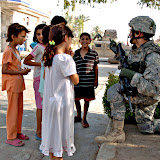
Sgt. Danil Ramirez, a Miami native and a team leader with 4th Platoon, Battery A, 2nd Battalion, 32nd Field Artillery Regiment, 2nd Brigade Combat Team, 1st Infantry Division, visits children in Western Baghdad, Iraq, July 26. Ramirez and other Soldiers were part of a joint operation with Iraqi security forces to disrupt insurgent activities in the area by searching residents homes for contraband.

Saturday, July 28, 2007

Strife and Ice, Staples of Life, Overlap in Iraq

Strife and Ice, Staples of Life, Overlap in Iraq
NY Times
July 28, 2007

BAGHDAD, July 27 — Each day before the midsummer sun rises high enough to bake blood on concrete, Baghdad’s underclass lines up outside Dickensian ice factories.

With electricity reaching most homes for just a couple of hours each day, the poor hand over soiled brown dinars for what has become a symbol of Iraq’s steady descent into a more primitive era and its broken covenant with leaders, domestic and foreign.

In a capital that was once the seat of the Islamic Caliphate and a center of Arab worldliness, ice is now a currency of last resort for the poor, subject to sectarian horrors and gangland rules.

In Shiite-majority Topchi, ice makers say that Moktada al-Sadr’s Mahdi Army issued a diktat on the first day of summer ordering vendors to set a price ceiling of 4,000 dinars ($3) per 55-pound block of ice, 30 percent less than they charge in areas outside Mahdi Army control.

Everyone complied, delivering an instant subsidy to the veiled women and poor laborers who are the radical Shiite cleric’s natural constituency. The same price is enforced in his other power bases, like Sadr City.

Some suppliers are horrified. “They are trying to improve their image, and gain favor,” a merchant grumbled, as a sickle-wielding colleague chopped the hollow crystalline blocks in half for black-robed women to cram into shopping bags. “But it won’t do much good, we all know what the Mahdi Army are.”

Wearied by four years of chaos, others support the move to reimpose order, any order.

“There is nothing better than law and order,” said Omar Suleiman, another factory manager. “In the days of Saddam Hussein, the government used to control the price of ice. Now there is no control, except where the militias are doing it.”

Shiites are not alone in manipulating supply to suit their own sectarian agendas.

At one plant, situated under a highway overpass in Topchi, all four delivery drivers quit last year after warnings that sectarian gangs would kill them if they continued to drive across the invisible but all-too-real lines dividing Baghdad’s Sunni and Shiite neighborhoods.

Customers in one suburb cautioned them that takfiris — fanatical Sunni extremists — had decreed their frozen product un-Islamic.

“In Ghazaliya, it is forbidden to sell ice because the takfiris said, ‘The Prophet Muhammad had no ice in his time,’ ” said Khatan Kareem, a manager at the factory where the drivers worked, shaking his head at the absurdity.

Many of Baghdad’s ice plants are museum pieces. In one, the industrial compressor was manufactured in India in 1960. Another’s was built by L. Sterne & Co. in Glasgow more than half a century ago.

Hussam Muhammad, whose family owns the equipment in the business where Mr. Kareem works, never imagined that the dilapidated factory, built in 1952 when Iraq was still a monarchy, would survive into the post-Saddam Hussein era.

“In 2003, I thought the ice business would be finished because everyone would have electricity and refrigerators once the Americans arrived,” Mr. Muhammad said as he scuttled from fan belt to ice-blistered piping trying to keep the plant limping along. “The fish sellers and meat stores who used to buy from us are gone, closed because of the security situation. Now it is the poor people who come because they don’t have money to pay for generators to keep their food and drinks cold.”

Baghdad’s sectarian compartmentalization of ice is as rigid for customers as for deliverymen.

Such is the fear of the gunmen that at the factory under the overpass, only the immediate neighbors can safely reach its grimy doors.

“People used to come here from Sunni areas, Taji, Amiriya and Jamiya to buy ice because they had no ice factories in their areas,” Mr. Kareem said. “But the Sunnis cannot reach this area now, and I am the same. I am Shia, and I cannot go to Yarmouk.”

The thought is particularly rankling to Mr. Kareem because until three months ago he lived in Yarmouk, a Sunni neighborhood, and enjoyed a secure government job, until an Iraqi Army raid uncovered a Shiite icon on his wall.

“They beat me up, burnt my house and forced me out of the area,” he said, squatting amid the nauseating smell of ammonium that permeates all ice factories. “I now live in my relatives’ kitchen. And I work here.”

His depression reflects the frustration of the Iraqi middle class, which prided itself on being one of the most educated in the Arab world, but now sees itself falling further behind its regional rivals and back onto the technology of its grandfathers.

In wealthier districts consumer goods are stacked high on shelves, for the “haves” who can afford to buy black-market electricity from private generator owners.

But millions of “have-nots” cannot afford this luxury, and many of those generator owners have now been killed or driven away by militias intent on securing their lucrative assets.

Ice, ostensibly the least political of commodities, requires only water, electricity and a few chemicals.

But in Baghdad’s current state of polarized violence, no business is an island. Raw materials must pass the checkpoints and gunmen, with their arbitrary rules and instant punishments, as must customers, suppliers, staff and the finished product.

The ice factories — cash cows in the peak summer season — have not escaped the gunmen’s notice.

In the Sunni enclave of Adhamiya, newly walled off from its Shiite neighbors to halt cross-community slaughter, Taha Khaleel complained that his drivers and mechanics were at the mercy of the Shiite-dominated Iraqi Army checkpoint that controls the gate.

“It depends on their mood,” he said. “This causes problems for us in the continuity of fuel supplies. The drivers are more reluctant to come to us now because of that, and because of the insults they face.”

A kidnapped factory owner in Taji was released only after he surrendered his car. At the Qutub Ice Factory in Baghdad, the owner has already fled Iraq after receiving a death threat, and employees say most of its middle-class customers have also gone.

Not so fortunate are the poor buyers in a street market the Salaam neighborhood, where wooden ice shacks have sprung up in recent months, despite the adjacent sewage and piles of rotting garbage.

Alarmed by tales of disease, many buyers now drop sterilization pills into the frozen blocks. If they are lucky, the stores will have ice from Sulaimaniya or Erbil, Kurdish cities where it is made from clean mountain water. If unlucky, the impure Baghdad product, with its distinctive yellow sheen.

“I never used to buy ice in Saddam’s regime, because I could use my refrigerator. But nowadays I have to because there is no electricity, and we need cold water,” said Muhammad Abbadi, 52, the owner of a clothing store. “Ice is the only source, even if it is dirty. Both my girls fell sick with typhoid two weeks ago.”

Reporting was contributed by Khalid W. Hassan, Ahmad Fadam, Wisam A. Habeeb, Karim Hilmi and Mudhafer Al-Husaini. Mr. Hassan was killed July 13.

Friday, July 27, 2007

Photos: Artilleryman Patrols Mansour

Photos: Artilleryman Patrols Mansour
Digital Video and Imaging Distribution System
Photographer: Spc. Leith Edgar
July 27, 2007

artilleryman patrols mansour


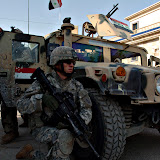
Pfc. Brandon Tripp, 26, a native of Jackson, Ohio, and an artilleryman with 4th Platoon, Battery A, 2nd Battalion, 32nd Field Artillery Regiment, 2nd Brigade Combat Team, 1st Infantry Division, pulls security in front of an up-armored Humvee of Iraqi army soldiers in Hateen, a neighborhood in Baghdad’s Mansour District, Iraq, on July 26. The joint operation between coalition forces and Iraqi security forces disrupted insurgent activities in the area through a cordon and search of residents’ homes.

Photos: Protecting, Patrolling Mansour

Photos: Protecting, Patrolling Mansour
Digital Video and Imaging Distribution System

Photographer: Spc. Leith Edgar
July 27, 2007

patroling, protecting mansour

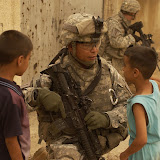
Sgt. Danil Ramirez, a Miami native, and a team leader with 4th Platoon, Battery A, 2nd Battalion, 32nd Field Artillery Regiment, 2nd Brigade Combat Team, 1st Infantry Division, pulls security in Hateen, a neighborhood in Baghdad's Mansour District on July 26. The joint operation between coalition forces and Iraqi security forces disrupted insurgent activities in the area through a cordon and search of residents' homes.

Hot in Tehran: Iran's global-warming agenda

Hot in Tehran: Iran's global-warming agenda
National Review Online
CBS News
Daveed Gartenstein-Ross
July 27, 2007

Daveed was embedded with the 2-32 for a few days back in June.

Excerpt:

Iran’s most obvious maneuverings have been in Iraq, where it has long aided insurgent factions. During a recent trip to Baghdad, where I was embedded as a reporter, I found that virtually every American soldier feared the explosively formed projectile (EFP). This kind of bomb has been described as uniquely dangerous because “when it detonates, the concave end blows outward and melts into a bullet-shaped fragment that slices through armor and flesh.” Captain Greg Hirschey of the Army’s 717th Explosive Ordnance Disposal Company told Wired of an incident where an EFP went through a Humvee, taking off both of the driver’s legs and also an arm. Lieutenant Patrick Henson of the 2nd Battalion, 32nd Field Artillery told me that he saw video in which an EFP went straight through a heavily armored Humvee and left an impact on the curb on the other side of the road. (Several Army sources corroborated his account.) Iran has been providing Shia insurgents with these deadly weapons. In 2005, Time reported that Iranian operative Abu Mustafa al-Sheibani, who headed an insurgent network created by the Iranian Revolutionary Guard Corps, introduced EFPs to Iraq. In February of this year, the American military stated that EFPs had killed “170 American and coalition troops in Iraq,” and the numbers have continued to rise since then.

Thursday, July 26, 2007

Are These Your Soldiers Too?

Are These Your Soldiers Too?
Daggers Edge Magazine
By 1st Sgt. Robert Cook
July 26, 2007

So there I was, no kidding, right in the middle of Baghdad when I began to ponder, what is it that I can say or write about for our newsletter that has not already been mentioned? What was out there or what has happened that I can highlight and still bring credit to our hard working Soldiers? As I began to drive on with my daily workload of paperwork, I came across the Battalion Commander's "Command Philosophy". What stuck out the most to me were the three words that drive him daily and how he expects the Soldiers to internalize these same three words. The three words are: competence, confidence, and courage. I thought to myself for a moment and realized, our Soldiers are already living by and using these three words.

I believe our Soldiers are very competent. When we first learned of our mission prior to going to the National Training Center (NTC), I had a lot of doubts. Here we were, a new unit still training within our own field of expertise and we were going to have to switch our focus to becoming infantrymen. This required a lot of man hours and a lot of training and retraining, not to mention working closer to our infantry counterparts to acquire information on tactics not common to us. There were quite a few reasons to be doubtful and it had been clearly stated numerous times as we took on this mission.

As we began to go through the training at NTC, the worries lessened just a bit. It seemed as if the training we did prior to departing Fort Riley had paid off some. I mean, we still had areas we needed to work on, but we were able to see how quickly our Soldiers had adapted. Now, as they patrol the streets of Baghdad, they appear to be no different than the infantrymen who once trained us. Sometimes, and even quite often, they seem to do it better than the infantrymen we see out in Baghdad and on FOB Liberty. Our guys and gals are becoming more and more skillful by the day and are truly a force to be reckoned with, when and if encountered.

The word courage in the dictionary is defined as the "mental or moral strength to venture, preserve, and withstand danger, fear, or difficulty." This definition could not even begin to describe what our Soldiers display each and everyday. In fact, I will tell you what courage is. Courage is going across the seas to face an enemy who has no face, an enemy who can be anywhere at all times. Who faces such a thing on a daily basis? Your Soldiers do. Courage is going into a foreign city to bring peace to its residents. Courage is working in a place, day in and day out, where you encounter different cultures, languages, and people; people displaying the mixed emotions of relief and anger that you are in their city. Daily we send our Soldiers out to gain the respect and trust of people they do not even know in the hope that we will gain an ally or a friend who can help us defeat our enemies. Could you do a thing of this magnitude? Your Soldiers do.

Courage is moving from a semi-secure place into a dangerous city full of Improvised Explosive Devices (IED), machine gun fire, rocket explosions, blocked streets, and harsh temperatures well above 110�. Who in their right mind willingly faces such dangers? Your Soldiers do. So, if you were to look at the dictionary definition of the word courage, I will bet it is incomplete because the true definition of courage includes the American Soldier.

Finally, if there is one thing our Soldiers have plenty of, it is confidence. They believe that they are bringing about a change in the area we secure, and why not when they see new shops opening and people openly cooperating with us? They watch the black marketers flee the area when their vehicles turn the corner. They hear the residents tell story after story about improved safety, they see more children outside without fear of violence, and they see more families moving home for the first time in months or years.

As our Soldiers ride through the city, they see the trash being picked-up, fences being repaired, and sewage waste and sewage systems being cleaned-up and redone. All of this is a result of their efforts to establish a safe and secure environment. So ask yourself, why not be confident in our mission or our accomplishments? I think that you would be and you would show it with as much pride as our Soldiers do. They are not the only ones who feel this way - leaders at every echelon of command talk about the work that our Soldiers do every single day.

The only thing extra I can say of our Soldiers is that they are relentless because they know if they do not do this mission, no one will. We are a field artillery battalion with less than half as many Soldiers as an Infantry Battalion, and yet, we make it happen. It has not been easy and there has been sacrifice. Our young guys and gals are drained, but they know they will be replenished. They are worn by exhaustion and fatigue, but they know that they will be re-energized when their mission is done. They fight complacency, shaking it off and returning to the basics to stay focused and vigilant. Our Soldiers endure all of this not for recognition or glory, or even some promised fortune or fame; they do it out of pure dedication to duty and the simple fact that staying loyal and committed to this fight may, one day, free this country from the tyranny of violence it has endured for over 35 years. They do it because they are American Soldiers, joined with others fighting for a cause, but most importantly, they do it because they are PROUD AMERICANS!

Security Developments In Iraq

Iraq Slogger
Security developments in Iraq
Tuesday, July 24, 2007:


BAGHDAD - Two Iraqi soldiers were wounded in a roadside bomb explosion at Qahtan Square in the Yarmouk district of western Baghdad on Tuesday morning, police said, according to Reuters.

Tuesday, July 24, 2007

Roundup of Daily Violence

Roundup of Daily Violence
McClatchy Newspapers
Mohammed al Dulaimy
July 24, 2007

Around 9 a.m. A road side bomb targeted an Iraqi army convoy in Qahtan square near Al Yarmouk hospital. 2 soldiers were injured and one military vehicle was damaged.

Sunday, July 22, 2007

Dagger Brigade Weekly Slides

Dagger Brigade Weekly Slides
Dagger Brigade Combat Team Official Site
Week: July 16- July 22
Slides: 24, 25, 26

Awards Ceremony
LTC Lawson
SGT Smith
SPC Voight
awards given: CAB, PH, ARCOM
A Little Proud American
1LT Nick, Emily, Olivia Bell, and family
Combined Security Forces Help Daklea Health Clinic
CPT Jayson Morgan
PV2 Steve Robbins

Thursday, July 12, 2007

Changes

Changes
2BCT Newsletter : The Dagger's Edge
By Sgt. 1st Class Daniel McKim
July 12, 2007

Waking up at 3 o’clock in the morning to head out to my truck and go hunting holds a different meaning here in Iraq than it does in the States. For one, my typical packing list of a shotgun, reflective safety vest, and a thermos of coffee does not help much with the conditions here. Instead of ducks, I now hunt terrorists, and as I get in my truck, I bring my rifle, tactical vest, and a block of ice that will eventually melt into the cold water I will drink while on patrol. It is funny that all of us think about what we would rather be doing; for some of us, it is drinking a beer with family members at a summer barbecue, or taking a swim with the kids at the beach. Despite the separation from our friends and family, the memories we create here are still significant. Time in Iraq moves slowly, and free time is a rare and precious commodity, but the constant support that the men show each other creates a home away from home. The men that I work with on a daily basis are at the forefront of all my thoughts here; their safety, health and welfare are my greatest concerns. But like me, I know they fight everyday to create a small world in their minds where they are ‘not a Soldier.’ This is not to say that they do not love Soldiering, it simply means that their families, friends, and stateside ways of life are among their fondest memories. Following each mission, as I walk back from the command tent, I pass through the Soldiers’ tent make sure the guys are doing well.

On any given day, I can find Pvt. Andrew Walker trying to master the latest riffs on his Guitar Hero game or Sgt. Jason Billings on his way out to call his wife. Staff Sgt. Jeremiah Brennan manages to squeeze in an afternoon nap, while Spc. Jonathon Larson continues to pursue his correspondence courses online. One fact stands out, these men, like all Soldiers deployed around the globe, have managed to forget about those long missions and the inherent dangers of being deployed, and have created a piece of home in Iraq. Even I have occasionally cracked open a book to escape the intensity that surrounds us.

But what of the families we left behind? I know that regardless of our mission, the people we left behind are still anxiously awaiting our return. Our biggest fears are the natural changes that occur during deployments. Yes, we will be gone for over a year, and yes we will adapt according to our new environment, but just as the part of our minds which remains fixated on memories of home, so too do our memories of those we left at home stay the same. That being said, we imagine that people are still the same… But we know that is not the case.

All of us have and will continue to change during such a long time away from our loved ones. I recall my last tour in Iraq when we received a redeployment briefing from the chaplain at the tiny FOB on the border of Iran that had become my home. It was time to begin to let the thoughts of combat seep to the back of my mind, and time to start focusing on redeploying and reuniting with family and friends. The changes that we underwent from being gone for so long framed every experience in a different light. As I begin to think of what the chaplain said, I realize that we have not had much contact with our families, and the simple sensors of our minds are disjointed as a result of being members of an all-male unit. Some of us surely will say a few more curse words than we did in the past, and some table manners have certainly fallen by the wayside. But these small changes can only be expected when you live, work, sleep and eat next to each other day-in and day-out in such close quarters.

Thinking back to the chaplain's words of wisdom, I am reminded that our parents, wives, children and friends will also change in many ways. Wives may undertake new careers or find new hobbies to pass the time. Children may become accustomed to different treatment from one parent when the other is deployed, and may even get away with things that Dad would not have allowed. Friends normally do a great job of staying in touch, but some have surely gotten married and started families of their own.

We are closing in on the five month mark of our deployment, and the R&R program is in full swing - roughly two soldiers per platoon (10 soldiers from the Battery) are home at any given time, visiting family and friends while getting some well-earned rest. Some plan on getting married, while others will hold their newborns for the first time. No matter what their plans, it is good to see Soldiers get this time off. The excitement they show upon their return and the stories that they bring back with them help pass the time on long patrols and never-ending guard shifts at Joint Security Station Torch.

During this deployment, each person will discover something about themselves that they did not know prior to arriving in Iraq. Some will find newfound strengths to bring home with them, while others may find weaknesses to correct while we are abroad. Some Soldiers will sustain their discipline and make the most of their time here; others may be able to embrace the many changes on home front because war has taught them to be adaptable in nature.

Iraq is an ever-changing, fast-paced world unlike anything else we will ever experience. As the war here continually changes, so too does every other part of our lives, and a phrase keeps coming to mind that I heard growing up..."Sometimes change is good, even if it’s bad."

Photos from journalist Nikola Solic

Photojournalist Nikola Solic has been embedded with one of the B-Battery platoons, and many of his pictures have been picked up by Reuter's, Yahoo News, and the NY Times.


All of Nikola's pictures can be found here


As I do a better job of picking out the relevant ones, I'll add to the list below:

Lt. Henson pouring out black-market gasoline


.

NY Times Photo-Op

New York Times
BUSH TO DECLARE PROGRESS IN IRAQ ON SOME FRONTS
July 12, 2007, Thursday


taken by Nikola Solic, photojournalist embedded with one of the B Battery Platoons; appeared in print on pg A-11.

Lt Patrick Henson is in the center; the first American soldier to the right of the Iraqi police officer.

unfortunately, I don't think I have the full text copied, but the story really wasn't about the 2-32.

Monday, July 9, 2007

Two-day clearing operation in Mansour nets cache, community support

Two-day clearing operation in Mansour nets cache, community support
Official Website of Multi-National Force - Iraq
BlackAnthem Military News
by: Multi-National Division - Baghdad POA Press Releases
July 8, 2007

BAGHDAD — Multi-National Division-Baghdad Soldiers, in conjunction with the Iraqi Army, conducted a two-day clearing operation in western Baghdad last week.

Task Force Patriot, the 2nd Battalion, 32nd Field Artillery Regiment, partnered with the 2nd “Falcon” Battalion, 5th Brigade, 6th Iraqi Infantry Division for the two-day operation, known as Operation Patriot Strike. The combined force cleared parts of the two neighborhoods of Hateen and Yarmouk in the Mansour District.

This was the first battalion-wide operation for the Patriots since Operation Arrowhead Strike IX in April and the first combined battalion-level effort for the Patriot and Falcon battalions. More than 100 Iraqi troops participated in the clearing operation.

The Patriot and Falcon leadership planned the operation together to combat violence in the area. Due to several improvised explosive devices, which either detonated or were found in the neighborhood, Coalition Forces and Iraqi leaders believed there to be an IED cell operating in west Yarmouk. They designed Patriot Strike to capture the members of this IED cell and clear the area of any weapon caches.

While Soldiers found no members of an IED cell, American and Iraqi troops did discover one cache of weapons and contraband. Additionally, the combined forces confiscated more than a dozen other illegally-owned weapons, mainly AK-47 assault rifless and pistols, and are confident that they have cleared the area of all illegal material.

Initially worried that the early morning hours of the operation would upset local residents, Patriot Soldiers instead found that the residents were receptive and opened their homes, eager to cooperate.

“The people seemed happy to let us search their houses. They fully cooperated with us as a way to prove that they are on our side,” said Sgt. 1st Class Rickie Jackson, a St. Louis native and platoon sergeant for Battery A, 2-32nd FA. Jackson added that the locals gave his platoon several tips about insurgents possibly operating in the area.

“This was an absolutely tremendous performance by our Soldiers and the soldiers of the Falcon Battalion,” said Lt. Col. Mike Lawson, commander of Task Force Patriot. “In just two days and despite the sweltering heat, our combined forces cleared over 500 homes. This will go a long way toward convincing the people of Hateen and Yarmouk that we’re here for their safety.”


Photos by 1st Lt. Ryan Stidum and 1st Lt. Matthew Offiler, 2nd Battalion, 32nd Field Artillery Regiment

Sunday, July 8, 2007

Dagger Brigade Weekly Slides

Dagger Brigade Weekly Slides
Dagger Brigade Combat Team Official Site
Week: July 2 - July 8
Slides: 40, 41

Deployment Relationship Workshop
CH Parson
SSG Brickner
PFC St. John
SGT Cope
SGT Carroll
NCO Induction Ceremony
SGT Goodwin
SSG Woode
CSM Champagne
CSM Huffin

Friday, July 6, 2007

The Patriot Call: Iraq Edition, Vol 1, Issue 6

The Patriot Call: Iraq Edition
Volume 1, Issue 6
July 6, 2007

Includes:

'Command Philosophy': by LTC michael J Lawson

'Our Newest NCOs': by CSM William R Huffin

'Free Thinking': by CH Troy Parson

'Changes': by SFC Daniel MoKim

'A Day in the Life of a Platoon Sergeant': by SFC Timothy Brown

'A Day in the Life of a Liaison Officer': by SFC Matthew Franklin

'My First Time in Iraq': by SFC Samuel Popple


Yahoo News: Pictures of JSS Torch

On Yahoo! News, picked up from Reuters:

U.S. soldiers from the 2nd battalion, 32nd Field Artillery takes a rest, while in between patrols, inside the Joint Security Station in Baghdad's Yarmuk neighborhood early July 6, 2007.
REUTERS/Nikola Solic (IRAQ)

picture here

.

Sunday, July 1, 2007

Dagger Brigade Weekly Slides

Dagger Brigade Weekly Slides
Dagger Brigade Combat Team Official Site
Week: June 25 - July 1
Slides: 15, 16

2nd Platoon, Bravo Battery, gives CLS Class to Iraqi Soldiers
SPC John Mazurek
Unit Ministry Team Out On The Streets
CH Parson
PFC Brown
SPC Garret
JSS Torch


Saturday, June 30, 2007

Neighborhood advisory council returns to Hateen Headquarters in Western Baghdad

Neighborhood advisory council returns to Hateen Headquarters in Western Baghdad
Black Anthem Military News
By 1st. Lt. Brian Cooke, 2nd Battalion, 32nd Field Artillery Regiment
Jun 30, 2007


BAGHDAD, Iraq - Encouraged by improved levels of security, a western Baghdad neighborhood advisory council, or NAC, decided to return to its former headquarters in Hateen June 23.

Hateen, a neighborhood in the western Baghdad district of Mansour, established a NAC during a 2004 initiative by Coalition Forces to improve local governance. The Hateen NAC originally held its meetings in their purpose-build NAC Hall, but moved to the larger Mansour District Advisory Council Hall when violence escalated in their neighborhood last year.

In February, Battery A, 2nd Battalion, 32nd Field Artillery Regiment, attached to 2nd Brigade Combat Team, 1st Infantry Division, assumed control of Hateen as part of the greater Baghdad Security Plan. The battery's constant presence on the streets has quelled violence in the neighborhood, according to their commander, Capt. Brian McCall, of Junction City, Kan. McCall has attended every NAC meeting since arriving in Hateen and made bringing the meetings back to the neighborhood one of his top priorities. The Hateen NAC returned to its former headquarters last Saturday.

The Hateen NAC is chaired by Mohannid al-Saadi Abbas, and has three representatives, Hadi Zaid Hamza, Hassan Jafer Choban, and Abdul Karim Hussein Elwi. The four NAC members met with McCall June 23, along with his Iraqi Army counterpart, Maj. Muhammed of 2nd Battalion, 5th Brigade, 6th Iraqi Infantry Division, and had what McCall described as an extremely positive meeting.

"The NAC enjoyed being back in their old building," McCall said, "and were telling old stories about it."

The NAC members discussed a number of infrastructure improvement projects and a program to hire more workers in Hateen. More importantly, the Hateen NAC decided to permanently move back to their original headquarters. They also started to design a plan to expand the Hateen NAC Hall and add a park for children on the NAC grounds.

"This meeting was entirely NAC-driven," McCall said, impressed with the focus of the meeting. "This has been a welcome change to the sometimes reluctant pace of Iraqi politics."

Thursday, June 28, 2007

Joint Military Seminar Held In Baghdad

Joint military seminar held in Baghdad
Media Newswire
Black Anthem Military News
By 1st Lt. Brian Cooke, 2nd Battalion, 32nd Field Artillery
Jun 28, 2007

BAGHDAD - Battalion leadership from the U.S. and Iraqi armies held a leadership seminar focusing on joint operations and battle staff operations June 23 and 24.

Senior leaders from the 2nd Battalion, 5th Brigade, 6th Iraqi Army Division, the "Falcon" battalion, visited Camp Liberty to meet with the senior leaders of Task Force Patriot, the 2nd Battalion, 32nd Field Artillery.

The two battalions are partner units operating in the western Baghdad neighborhoods of Hateen and Yarmouk. Falcon and Patriot battalions patrol together on a daily basis and the senior leaders from both battalions have been meeting weekly since April to discuss operations at Joint Security Station Torch in Yarmouk. However, this was the first chance for the Iraqi leaders to observe the Patriot headquarters in action.

Col. Ali Al-Obaydi, commander of 2/5/6 IA, brought with him his executive and operations officers, and his top noncommissioned officer.

The 2-32 FA's executive officer, Maj. Jim MacGregor, led the formal portion of the seminar, briefing the Iraqi leaders on the composition and function of the Patriot staff. MacGregor focused on the staff's planning and targeting process, highlighting how the process supports the battalion commander's ability to make timely and informed decisions.

Once the formal briefing was over, Ali and Lt. Col. Mike Lawson, the Task Force Patriot commander, led an open discussion on the major challenges facing the units in their mission.

Lawson then took the Iraqis on a tour of the Task Force Patriot Tactical Operations Center. The tour gave the Iraqis a chance to see the way in which the battle staff tracks the battalion's operations and how the staff integrates all of its digital assets to provide an accurate picture of the battlefield to the commander.

"We're all soldiers, regardless of the flags we wear on our uniforms," said Lawson. "We're working together day-in and day-out to defeat a common enemy, and today was simply a great opportunity to remind ourselves why we're here in the first place."

Wednesday, June 27, 2007

Fixing Anytime, All the Time

Fixing Anytime, All the Time
2BT Newsletter: Daggers Edge V1, Iss16
SGT 1Class Gary Sarapa
June 27, 2007

The motto of the Maintenance Platoon of Golf Company, 610th BSB, which supports 2-32 Field Artillery is, “We fix anytime, all the time.” It is a motto by which every Soldier in the platoon lives. They know that their way of supporting the war is ensuring that all of the equipment used by the “Proud Americans” is not only fully mission capable, but to high operational standards as well. The platoon itself is a miniature maintenance company, capable of performing field level maintenance on every piece of equipment owned by 2-32 FA. It is comprised of an automotive section, ground support equipment (GSE) section, service and recovery (S&R) section, communications and electronics section, armament section, and a maintenance control section.

During the past month alone, the automotive section has put in over 200 man-hours, bringing most deadlined vehicles back to FMC status the same day. They work 24 hours a day, seven days a week. When the call comes in that a broken vehicle is returning from a patrol, the parts, tools, and mechanics are all standing by, waiting for the vehicle, ready to pounce on it like a NASCAR pit crew. The section also provides a three-man team with a wrecker and contact truck each week at Joint Security Station Torch. The forward team repairs equipment utilizing minimum resources until it can be brought back to the Forward Operating Base. They also provide welding and lift support for JSS improvement, as well as maintenance and repair of the generators on site that provide the JSS with power.

With the hot temperatures of late, the GSE section has also stayed busy repairing and recharging 14 vehicle air conditioners, earning the GSE section sergeant the nickname “Mr. Freeze” from the Soldiers in the battalion. He is the only air conditioner mechanic by MOS in the platoon, but he has ensured all of his Soldiers are crosstrained to provide seamless support to the Proud Americans and keep them cool. They have recently started replacing all of the front and rear evaporators in our battlehardened M1114 fleet, making a significant improvement in their cooling efficiency.

The S&R section, besides providing the recovery and lift capabilities for the battalion, has made its biggest impact on the battalion performing annual services on the battalion’s vehicles. Over the past month, they have completed services for ten vehicles, with an average turn-around time of only 24 hours each. This performance is impressive because, according to the Maintenance Allocation Chart, it should take them close to 37 hours each. This quick turn-around allows a vehicle to get back in the fight with the assurance that it is in the same shape as when it rolled off the showroom floor. A key part of the S&R section are the welders who have fabricated anything the battalion has asked for from warning light and pope glass brackets to crew-served weapons stands at the JSS.

Besides the vehicle services, there is also the requirement to maintain night vision devices, weapons, and communications equipment and this is where the C&E and Armament shops jump in to do their part. The C&E section inspected, purged, and repaired over 40 NVG during platoon services and the armament shop inspected, gauged and repaired over 60 individual and crew-served weapons. In their “spare time,” the C&E shop installed MP3 players into our vehicles’ public address systems so the platoons can transmit messages during their patrols.

The speedy repairs accomplished by all of the sections in the Maintenance Platoon could not be accomplished without the parts provided by the Maintenance Control Section. The parts specialists are constantly on the road, requesting and picking up parts from every warehouse on every FOB on the entire Victory Base Complex. They have already logged hundreds of miles without even leaving the wire.

Tuesday, June 26, 2007

Baghdad Residents Say Electricity, Water as Important as Security

Baghdad Residents Say Electricity, Water as Important as Security
By Margaret Besheer Baghdad
Voice Of America News
GlobalSecurity.Org
26 June 2007

The deployment of 28,000 additional U.S. troops to secure Baghdad is now complete. The troops began arriving in February, and have been focusing their mission on clearing troubled neighborhoods of al-Qaida and illegal militias. From Baghdad, VOA's Margaret Besheer reports on one area where U.S. and Iraqi forces are working to bring security and return basic services to residents.

The streets of Yarmouk are quiet in the searing mid-day heat. This western Baghdad neighborhood is one of the wealthiest in the capital and many of its residents have fled the sectarian killings, kidnappings, and bombings that have been gripping the capital during the past 16 months.

But after four years of war, residents here complain as much about the lack of electricity and water as they do about security.

Standing in her garden, as the generator hums in the background, a middle aged mother who identifies herself as Mrs. Samir says the municipality provides only one hour of electricity each day, there is trash everywhere, and cooking gas has become very expensive. She says the long lines at gasoline stations are particularly frustrating.

"One night my son goes from five o'clock in the morning, and he is still in the station at seven [in the] evening and he did not get anything," said Mrs. Samir.

Next door at Abdul Melhem's house, his family is in mourning for his brother who gunmen shot dead two days before. He agrees basic services are in shambles.

As his eyes fill with tears he says, it is one thing to lose services, but to lose people is a different issue. He says no one is safe at home or on the street.

But Iraqi Army Colonel Ali al-Obeidi, whose unit is responsible for security in the area, along with the U.S. Army's 2nd Battalion, 32nd Field Artillery, 1st Infantry Division, says in recent weeks about 100 families have returned to the area, a sign their confidence is rising.

He says the biggest problem security forces in this area faced was from al-Qaida. But in his view, all the al-Qaida members in Yarmouk have been now been apprehended and the area is relatively quiet.

Before the surge began in February, about 1,200 U.S. soldiers patrolled the Karkh security area, which includes Yarmouk. This 107 kilometer area of Baghdad now has about 3,000 U.S. soldiers. Working alongside them are 10,000 Iraqi soldiers and police.

Captain Jason Morgan of the 32nd Field Artillery says when his unit arrived four months ago there was one road in Yarmouk where they regularly found dead bodies.

"In past three months, we have had zero body drops on that road," he said. "I would say that is a pretty good metric for success."

Yarmouk's biggest problem appears to be the neighborhoods to the west and north of it, where problems still abound.

On a recent afternoon VOA visited the local police station, which also has responsibility slightly north of Yarmouk. A few hours later, the police captain in charge was killed.

He and other officers responded to a call about two dead bodies on a street in the northern area. When they arrived the booby-trapped bodies exploded and small arms fire rang out. The captain was killed and one of his men was injured.

When VOA visited the same police station about two months ago, the captain's uncle had just been kidnapped and killed.

Yet despite the violence, Yarmouk is safer than most Baghdad neighborhoods for locals and U.S. troops. Since American forces arrived in the area in February, not one U.S. soldier has been killed.

Monday, June 25, 2007

Multi-National Soldiers Secure Vulnerable Site

Multi-National Soldiers Secure Vulnerable Site
Defend America
Free Republic

BlackAnthem Military News
By Multi-National Division – Baghdad
Public Affairs Office
BAGHDAD, June 25, 2007

Iraqi and U.S. soldiers from the Multi-National Division-Baghdad are now fortifying a western Baghdad gas station that has been the target of recent insurgent attacks in the neighborhood of Yarmouk. The gas station, which serves the residents of southeastern Mansour, has come under small arms fire and two car bombs exploded within 100 meters of the gas station in recent weeks. These attacks prompted leaders from the 2nd Battalion, 5th Brigade, 6th Iraqi Division and 2nd Battalion, 32nd Field Artillery to take action.

“We’ve already begun to see an improvement in the traffic flow. Black-market fuel peddlers can no longer cut in the waiting line, customers are safer, and the whole process seems faster now.” U.S. Army 1st Lt. Ryan Stidum Col. Ali Al-Obaydi and Lt. Col. Michael Lawson, who assumed command of Task Force Patriot two weeks ago, made reinforcing the gas station one of their top priorities.

“The ability of this gas station to operate free from attack is vital to giving the Iraqi people normalcy in their lives,” Lawson said. He also stressed that keeping the gas station secure is one way that the battalions are working to safeguard the populace as they go about their daily lives.

Soldiers from the Iraqi army battalion took the first step in protecting the gas station by observing the traffic patterns at the station over the course of several days, noting trends in high-traffic times and looking for possible ways insurgents might attack the waiting customers. They turned their observations over to the combined staffs of the two battalions to come up with a plan to reinforce the gas station with concrete barriers.

In one night, soldiers from 299th Forward Support Battalion and Golf Company, 610th Brigade Support Battalion used heavy equipment haulers to move the barriers from Camp Liberty out to the gas station. They worked throughout the night to download the material from their trucks and used heavy-duty cranes to maneuver the barriers into position while soldiers from 2/5/6th Iraqi army and 2-32 Field Artillery provided security.

The overall effect, according to 1st Lt. Ryan Stidum, 2nd Platoon Leader, Bravo Battery, is a well-protected, better-organized gas station.

“We’ve already begun to see an improvement in the traffic flow,” said Stidum, “Black-market fuel peddlers can no longer cut in the waiting line, customers are safer, and the whole process seems faster now.”
photo by 1st Lt. Mike Hayhurst, 2nd Battalion, 32nd Field Artillery Regiment

Sunday, June 24, 2007

Dagger Brigade Weekly Slides

Dagger Brigade Weekly Slides
Dagger Brigade Combat Team Official Site
Week: June 18 - June 24
Slides: 19, 20, 21

Alpha Battery Soldiers Reenlist
CPT McCall
1LT Nguyen
PFC Michael Smith
SSG Magalit
SGT Michael Evans
SSG Frank Woode
Golf Company Reenlists
CPT Bandy
SSG Magalit
SGT Gary Payne
SGT Joel Starling
SGT Adrian Ray
Bravo Battery Undergoes CLS Refresher Training
PV2 Chapman
SGT Vincent
PFC Hutson
PFC Merritt
PFC Laing

Saturday, June 23, 2007

The Importance of Shaking Hands

The Imortance of Shaking Hands
2BT Newsletter: Daggers Edge V1, Iss15
1LT Matthew Offiler
June 23, 2007

When our Battalion first began patrols in Baghdad in early March, it was a shock to hear that our commander wanted us to dismount for our patrols and just talk to the locals as if they had been our long-time neighbors. It was a shock because on every one of our first patrols, we had been shot at. While it was an event we gradually became accustomed to, we continued to ask ourselves, “Why would I leave the relative safety of my HMMWV to get out and walk around in a neighborhood where people are shooting at me?”

It was a relevant question, but we began to dismount anyway. We would use our vehicles forgetting to and from our area and would spend the rest of the patrol conducting dismounted operations. It was an uneasy feeling at first since we were still new to combat. Keep in mind that the majority of the Soldiers in our platoon had never deployed and all of them, being Field Artillery, were new to the infantry mindset.

We learned quickly which tactics worked in which neighborhoods. In some areas, there were only certain people who would speak with us, while the rest ran back into their homes. In other areas, the locals would empty out of their homes and into the streets at the sound of our patrol coming around the corner. We adapted our vehicles’ maneuvering depending on the neighborhood as well. We either pull them up the middle of the patrol or let them stay towards the back. It is a balance between having your protection there if something happened and lowering your appearance of aggression when speaking with the friendly locals. This tactic adapted well for our platoon since our area has changed several times since our first patrols.

Correctly maneuvering the vehicles was only one part of creating a friendlier, but still safer atmosphere for the locals and my Soldiers. The one thing I never learned in any officer training course was how to be a politician, but it feels like that is where I have ended up. When I dismount, I greet the locals with hand shakes and smiles, feeling more like I am running for an election than fighting a war. But shaking hands has worked. It helps give them an understanding that you are there to work with them, not for them.

We shake hands and then begin the “small talk” of tactical questioning. Questions like “How long has the sewage been here?”, “Do you have a weekly trash service in this area?” and “How are the schools that your children attend?” Those questions get them to talk about their major problems and let us know what they are willing to speak about. Those questions, however, can also lead to more helpful intelligence. Information like, “We don't walk that way when we take our kids to school because we don't like the men in that house; they are dangerous men”. This is information which leads us to weapons caches and targets, information we would not have been able to gather if we had conducted our patrols by remaining in our “urban submarines” instead of shaking hands.

By talking with the locals, it shows them that you care and are at least trying to help. They all know you are just doing your job and we have encountered many locals who do not believe we are going to change anything. I cannot count the number of times I have heard, “You have been here for 4 years and you haven't fixed anything!”

Things have been fixed though, and it shows. Since we started dismounting, we have not received any small arms fire attacks on our patrols and have not had any IEDs placed in our area. There may be a number of factors to account for that, but I do not question for a moment that our tactics, shaking hands and sampling the local food offered to us have contributed greatly to this result.

Friday, June 22, 2007

Insurgents Attack Iraqi Civilians

BlackAnthem Military News
Insurgents Attack Iraqi Civilians
Multi-National Force - Iraq
2nd BCT, 1st Inf. Div. Public Affairs

June 22, 2007

Blackanthem Military News, BAGHDAD, Iraq — Five Iraqi citizens were killed when a 122MM rocket struck a building causing it to collapse in the Al Mansour
district of Baghdad June 19.

Both Iraqi Army and Coalition Forces responded to the scene of the attack after a rocket struck the building in the neighborhood of Yarmouk, causing it to collapse and kill five Iraqi citizens and wound six others. The Yarmouk hospital confirmed the casualties

U.S. Forces confirmed that the rocket was fired from north of the city approximately 10 miles away.

The 2nd Battalion, 32nd Field Artillery Regiment, was the first U.S. Force on site of the attack.

“This attack was not aimed at any specific targets. It is most likely a way to incite sectarian violence,” said Capt. Aquila Knopf, an intelligence officer for 2-32 FA.

Knopf went on to explain that the attack most likely originated from Jaysh Al-Mahdi militants and was directed at the Sunnis region of Al-Mansour.

Thursday, June 21, 2007

Iraq Operations Kill, Capture Scores of Terrorists

Iraq Operations Kill, Capture Scores of Terrorists:

"In other Iraq news, five Iraqis were killed and six injured June 19 when a 122 mm rocket struck a building in the Al Mansour district of Baghdad. Both Iraqi and U.S. military forces responded to the scene of the attack. U.S. officials confirmed that the rocket was fired from north of the city, about 10 miles away. The 2nd Battalion, 32nd Field Artillery Regiment, was the first American unit to arrive at the attack site."


Hope & frustration: The view from there

Hope & frustration: The view from there
Lancaster Online
By JANE HOLAHAN
Jun 21, 2007

The war in Iraq is often the top news story of the day, and mostly the news is tough to hear.

More than 3,500 American soldiers have been killed, and the Pentagon reports that more than 24,000 Americans have been wounded in action.

According to most major polls, about three quarters of the American people say the war is going badly and about 60 percent want a timetable for troops to begin withdrawing.

But what about the guys over there who are fighting the war? How are they feeling these days?

The New Era asked two men from Lancaster County serving in Iraq to talk about their experiences.

First Lt. Neal Rice, 27, executive officer of Alpha Battery, 2—32 Field Artillery, 1st Infantry Division, is stationed in Baghdad and does daily mounted and foot patrols. He answered questions via e-mail.

"Pressure is a way of life here," he explains. "The threat of roadside bombs, rocket and small-arms attack is constant."

Spc. Jonathan Webster, 23, of the Pennsylvania National Guard, is stationed at Camp Anaconda, at the Balad Airbase in Northern Iraq, working as a pay specialist, making sure soldiers are paid properly. He was on a three-day leave when he spoke by phone.

"My days are like the movie 'Groundhog Day.' That's what I consider my life here," Webster says, referring to the Bill Murray movie in which the same day is repeated over and over.

"Everyone says Anaconda is a safe zone, but we do get mortared almost every day," he says. "It's hit or miss, here and there. But it's basically safe."

While their experiences have been different, both men still hold out hope that victory will be achieved, both are frustrated by what they see as lack of support back home, and they both believe that the good things happening in Iraq don't get heard.

But they also talk about the stress this long war — four years and counting — is having on troops, about changing attitudes and, like soldiers from time immemorial, about how they are eager to come home.

***

"Some of the soldiers think it's time to come home, some think we should stay a decade if that's what it takes," writes Rice. "But their commitment to each other and to the mission in front of them is always strong."

Rice grew up in East Lampeter, graduating from Conestoga Valley High School in 1998 and Shippensburg University in 2002, with a bachelor of arts degree in political science and Spanish.

He joined the Army in 2004.

"As I watched the early stages of the Iraq War progress on the news, I felt a strong pull to serve the country in support of the war effort," he writes. "The more I watched, the more strongly I felt an obligation to serve."

Rice, who is single, was deployed to Baghdad about four months ago as part of the troop "surge" effort.

Webster, a 2002 graduate of Ephrata High School, joined the Pennsylvania National Guard when he was still in high school, mainly to help pay for college.

In 2005, Webster was sent to New Orleans to help with relief work after Hurricane Katrina. It was an incredible experience, he says.

Married and the father of three small children, Webster has been in Iraq since August, 2006 and is in an 18-month deployment.

"I think we are working toward finding victory, but it still needs to be given time," Webster says. "I would like to see us pull out, but I don't think we can just pack up."

Webster says there are mixed feelings about staying in Iraq among his fellow soldiers.

"Some are for us staying and fighting, some think that's a completely wrong idea," Webster says. "I have mixed feelings. When I first got here, I thought it was a good thing, but I'm not so sure."

"We try to stick together, to keep morale up high," he adds. "There are times when you don't want to be here..."

Webster's base houses between 30,000 and 35,000 people, including cooks, mechanics, contractors, construction workers and infantrymen.

He has a pretty straight-forward routine.

"I get up around 4:30 or 5 a.m., go to the gym, then report to work at 8:30. I get out around 5:30 or 6 p.m., go to chow, then hang out in my room, maybe watch TV, play my Nintendo, and I hit the sack around 11."

The chow is pretty good.

"I've gained 35 pounds," he says with a laugh.

Webster says soldiers are stressed out by the length of the war and especially deployment extensions.

"On the regular-Army side, once they found out that most of the units were extended, that really busted morale," says Webster. "Me, I just can't wait to leave and reunite with my wife and three kids."

Rice writes that morale is "pretty strong" among his soldiers.

"The level of morale fluctuates in response to several factors, including how long we go without any meaningful break, what the news media is saying, if a soldier gets care packages or not, and, especially, if our soldiers get injured."

The toughest setback came when his battalion commander was seriously injured when his truck was hit by an improvised explosive device (IED) about six weeks ago.

"The doctor was able to save his life by amputating one of his legs," Rice writes. We're very thankful he will live, but it is tough when your leader, the man you look to for inspiration, goes down."

Rice is frustrated by the media's coverage of Iraq.

"Violence and destruction sell newspapers and get people to tune in their TVs. I understand the economics of it," he writes. "I wish they could see the progress too. My troops work tirelessly to make progress here. The improvement in schools, business, health clinics and neighborhoods is steady and significant."

Rice explains that the days all run together, but that the pace is fast and draining.

"Generally, we patrol six days a week, reserving one day to maintain and repair our vehicles, weapons and equipment," he says. "The pressure is so pervasive that it's not really stress anymore, it's simply normal."

Engaging with Iraqis is a big part of the mission.

"The only way to make progress is to hit the streets every day, talking with the people and helping them to understand what we're trying to do," he writes. "Iraqis are receptive and friendly towards us most of the time."

Rice believes the surge can work if it's given time.

"We are working incredibly hard to live among the people here, to show them we care and to humanize our presence," Rice writes. "For too long, the Iraqi people's perception of us was that we're closed up in our HMMWVs and Bradleys, that we don't talk to them and don't care about them.

"The new approach gives us an opportunity to engage the people more and to show them we're here to help. We get many tips and more cooperation in general because we're on the street level with the people. It exposes us to more attacks, but it will be worth it so long as we keep building rapport with the people."

Ultimately, though, Rice writes that it's up to the Iraqis.

"I'm convinced if the war is lost it won't be because we didn't work hard enough or believe in it enough."

Both Rice and Webster say they know American support for the war is waning. Do they tie that to support for them?

"Yes, I take it personally," says Webster. "Losing support back home is a morale breaker. We do get the feeling that people don't support us when we hear the news and politics back home."

Rice has complicated feelings about the situation. In an initial e-mail, he says it is not possible to differentiate support for the troops and support for the war.

But in a subsequent note, he explains that his earlier response was "a little rash."

"I was thinking more along the lines of politicians because at the time there was such a debate about the funding bill in Congress and whether or not troop withdrawals should be tied to it," he writes.

"After thinking about it further, it is possible (to support the troops but not the war). Among all the people who are kind enough to support me while I'm here, I'm not sure all of them support the war itself. Yet they support me in care packages, encouraging notes, e-mails and prayers."

The two men agree that support from friends and family is incredibly important.

"Luckily for me and my men, we have an outstanding group of people who have personally sponsored each of my soldiers by sending them care packages and letters every month," Rice writes. "Most of them are from Lancaster. That has helped greatly in keeping our morale high."

Monday, June 18, 2007

Iraqi Army, Coalition forces discover weapons cache in Yarmouk

Operation Iraqi Freedom:
Official Website of Multi-National Force - Iraq:
Freedom Journal, Iraq
Iraqi Army, Coalition forces discover weapons cache in Yarmouk
by 1st Lt. Brian Cooke, 2nd Battalion, 32nd Field Artillery Regiment PAO
Monday, 18 June 2007


BAGHDAD — Iraqi Army Troops and Multi-National Division–Baghdad Soldiers, uncovered a large cache of explosives and bomb-making materials in the western Baghdad neighborhood of Yarmouk Wednesday.

Iraqi troops from 2nd Battalion, 5th Brigade, 6th Iraqi Army Division initially discovered a weapons cache while on patrol in the Yarmouk neighborhood. The cache contained 113 land mines, 63 grenades, three rockets, three mortars, two gas masks, five washing machine timers, more than 2000 rounds of AK-47 ammunition and seven boxes of various electronics and other assorted explosives.

It is the largest weapons cache discovery by either Iraqi or Coalition forces to date in the Yarmouk area. The Iraqi troops quickly notified their liaison officer at Joint Security Station Torch, where Iraqi Security Forces and Coalition forces live and work together.

“This is just more proof to us that having the JSS and being out in the community is what’s allowing us to work so effectively with the Iraqi Army,” said U.S. Army Major Jim MacGregor, executive officer of 2nd Battalion, 32nd Field Artillery Regiment.

The 2-32nd Field Artillery Regt. received the report and sent a patrol to the site of the cache to assist the Iraqi troops. Upon arrival the U.S. patrol leader, U.S. Army 1st Lt. Nick Bell, received an update from the Iraqi battalion commander, Iraqi Army Col. Ali Al-Obaydi.

Ali told the lieutenant that a gardener was trimming the bushes of an empty house he was caretaking and noticed several bags hidden behind the shrubs. Upon closer inspection, the gardener identified what he believed to be hand grenades and promptly called the Iraqi Army for help. Ali responded to the call and then sent word for U.S. assistance to dispose of the explosives.

This tip coming from a local resident is another sign of progress in Yarmouk, McGregor said.

“The people of Yarmouk are showing us that they are ready to stand up against violence and make their neighborhood’s better places to live,” he said.

Bell and Ali’s troops set up a joint cordon of the area to secure the cache and ensure the safety of local residents. Once the area was secure, an explosive ordnance disposal team was called in to destroy the munitions.


U.S. Army photo by 1st Lt. Patrick Henson, 2nd Battalion, 32nd Field Artillery Regiment

Sunday, June 17, 2007

Dagger Brigade Weekly Slides

Dagger Brigade Weekly Slides
Dagger Brigade Combat Team Official Site
Week: June 11 - June 17
Slides: 30, 31, 32

Golf Company Soldiers Reenlist
CPT Bandy
SSG Santos
SPC Bell
1LT Lowry
PFC Day
SGT Shultze
Assumption of Command Ceremony
CSM Huffin
LTC Lawson
Golf Company Soldiers Use VTC, Talk To Families
SPC Pechin
1SG Ruiz
SSG Brickner
PFC Quick

Friday, June 15, 2007

US, Iraqi troops uncover large weapons cache in Yarmouk neighborhood

Black Anthem Military News:
US, Iraqi troops uncover large weapons cache in Yarmouk neighborhood
By 1st Lt. Brian Cooke, 2nd Battalion, 32nd Field Artillery Regiment
Jun 15, 2007

Blackanthem Military News, BAGHDAD, Iraq - Multi-National Division - Baghdad Soldiers, working in conjunction with Iraq Army troops, uncovered a large cache of explosives and bomb-making materials in the western Baghdad neighborhood of Yarmouk June 13.

Iraqi troops from 2nd Battalion, 5th Brigade, 6th Iraqi Army Division initially discovered a weapons cache while on patrol in the Yarmouk neighborhood. The cache contained 113 land mines, 63 grenades, three rockets, three mortars, two gas masks, five washing machine timers, more than 2000 rounds of AK-47 ammunition and seven boxes of various electronics and other assorted explosives.

It is the largest weapons cache discovery by either U.S. or Iraqi forces to date in the Yarmouk area. The Iraqi troops quickly notified their liaison officer at the Joint Security Station Torch, where both Coalition and Iraqi Security Forces work and live together.

"This is just more proof to us that having the JSS and being out in the community is what's allowing us to work so effectively with the Iraqi Army," said Major Jim MacGregor, executive officer of 2-32nd FA.

The 2nd Battalion, 32nd Field Artillery Regiment received the report and sent a patrol to the site of the cache to assist the Iraqi troops. Upon arrival the U.S. patrol leader, 1st Lt. Nick Bell, received an update from the Iraqi battalion commander, Col. Ali Al-Obaydi.

Ali told the lieutenant that a gardener was trimming the bushes of an empty house for which he was the caretaker, and noticed several bags hidden behind the shrubs. Upon closer inspection, the gardener identified what he believed to be hand grenades and promptly called the Iraqi Army for help. Col. Ali responded to the call and then sent word for U.S. assistance to dispose of the explosives.

McGregor pointed to the tip coming from a resident as another sign of progress in Yarmouk.

"The people of Yarmouk are showing us that they are ready to stand up against violence and make their neighborhood's better places to live," he said.

Bell and Ali's troops set up a joint cordon of the area to secure the cache and ensure the safety of local residents. Once the area was secure, an explosive ordnance disposal team was called in to destroy the munitions.


US Army photos by 1LT Patrick Henson, 2nd Battalion, 32nd Field Artillery Regiment

Tuesday, June 12, 2007

'Patriots' uncover cache, capture suspected terrorist in western Baghdad

'Patriots' uncover cache, capture suspected terrorist in western Baghdad
BlackAnthem Military News
By 1st Lt. Brian Cooke, 2nd Battalion, 32nd Field Artillery
Jun 12, 2007

BAGHDAD, Iraq — Multi-National Division- Baghdad Soldiers, in cooperation with Iraqi Security Forces, conducted a raid in the western Baghdad neighborhood of Hateen June 10, uncovering a cache of bomb-making materials and capturing a terrorist suspect believed to be linked to al-Qaeda in Iraq.

“We’ve been looking for this guy for some time,” said 1st Lt. Kevin Mills, a tactical intelligence officer with 2-32nd FA. Mills said the operation’s success can be attributed to the cooperation and shared intelligence between U.S. and Iraqi Security Forces.

Soldiers from the 2nd “Patriot” Battalion, 32nd Field Artillery Regiment, attached to 2nd Brigade Combat Team, 1st Infantry Division, acted on a tip and apprehended the alleged al-Qaeda member. The troops also found approximately 500 boxes of toilet bowl cleaner and 20 boxes of circuit breaker covers, which can be used to build improvised chemical weapons.

Mills said the planning and coordination for this operation took place at Joint Security Station Torch in the Yarmouk neighborhood, near the site of the raid. The raid was a product of coordination and cooperation between the Patriot Battalion and members of the 2nd Battalion, 5th Brigade, 6th Iraqi Army and the Yarmouk Iraqi Police.